
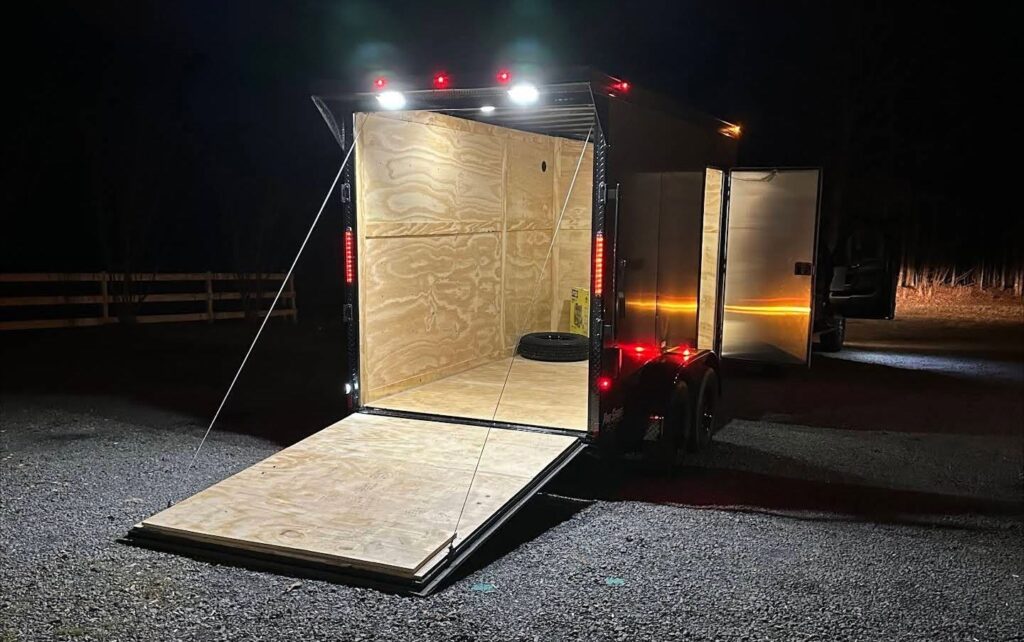
The rear door is the one you open on every single load, so it deserves as much thought as the length of the trailer. An enclosed trailer ramp door is hinged at the bottom and folds down to become your loading ramp. Barn doors are two doors hinged on the sides that swing open like a pair of cabinet doors. If most of what you haul rolls, get the ramp door. If you load by hand, off a dock, or park with no room behind the trailer, barn doors make more sense.
Key takeaways: A ramp door is the right call for anything on wheels. Barn doors need room to swing out to the sides but no ground behind the trailer. On either style the door opening is shorter than the inside of the box, so measure your tallest item against the opening. Check where you will park and load before you pick a door.
How an Enclosed Trailer Ramp Door Works
A ramp door is a single rear door hinged at the bottom. It lowers to the ground and you load right over it. Spring assist takes most of the weight, so one person can raise and lower it. Closed, it seals the back of the trailer and locks like any other rear door.
The Header Takes Some Height
There is a header across the top of the rear opening, and on a ramp door trailer that is where the spring hardware usually lives. That header is why the doorway is shorter than the inside of the trailer. On the Stealth 7x16 XLT Pro built by ALCOM, the interior is 76 inches tall and the rear door opening is 72 inches. Measure what you load against the opening, not the interior.
What a Ramp Door Is Best For
A ramp door turns the back of the trailer into a drive-on surface. That suits mowers, motorcycles, ATVs, golf carts and rolling tool chests. You also don't have to carry and stow a separate set of ramps. If you load wheeled equipment more than once in a while, the ramp door pays for itself in time. If yours takes heavy daily use, our guide on how to reinforce a cargo trailer ramp door covers ways to keep it solid.
How Enclosed Trailer Barn Doors Work
Barn doors are two rear doors hinged on the sides. They swing out and latch open, and you get the full width of the opening with nothing lowering to the ground. Most enclosed trailers come with one style or the other at the rear, and you can usually order either one.
Where Barn Doors Make Sense
Barn doors fit cargo that goes in by hand, on a hand truck, or off a raised dock, where a lowered ramp would just be in the way. They also work for buyers who back into tight spots, since nothing has to drop down behind the trailer. Contractors who haul boxed material and shelving often like them for quick step-in access.
The Limits of Barn Doors
Barn doors don't help you with anything on wheels. To roll equipment in you need separate ramps, and those have to be stored, carried and set up on every job. The doors also need room to swing out to the sides, which gets tight in a narrow driveway or next to another vehicle.
Ramp Door vs. Barn Doors at a Glance
The right rear door comes down to how you load and where you park. Here is how the two compare day to day.
| Factor | Ramp Door | Barn Doors |
|---|---|---|
| Loading wheeled cargo | Built-in ramp, drive or roll on | Needs separate ramps |
| Loading by hand or from a dock | Ramp can get in the way | Full-width, step-in access |
| Space needed behind the trailer | Several feet of clear ground for the ramp | Very little, but room to swing to the sides |
| Operation | Spring assisted, one person | Swing open and latch |
Plan the Space Before You Buy
A ramp door needs several feet of clear ground behind the trailer to come down. Barn doors need room to swing out. If the trailer is going to live in a garage, a storage lot or a tight driveway, measure the space for the door you choose, not just the length of the trailer. Our enclosed trailer size guide helps you match the trailer itself to the space and the cargo.
A Third Option: Skip the Rear Door Problem
Some specialty enclosed trailers get around the question. Air-Tow builds enclosed drop deck trailers where the whole deck lowers to the ground, so there is no ramp to climb at all. If you load heavy wheeled cargo every day, that design is worth a look. See our Air-Tow trailers page.
How to Choose the Right Rear Door
Answer these honestly and the right style is usually clear before you ever get to the lot.
Does most of what you haul have wheels? If yes, the ramp door wins.
Do you load by hand or off a dock more than you roll cargo in? If yes, barn doors are the better fit.
Where will the trailer be parked and loaded? If there is little ground behind it, barn doors may be the only practical choice. If there is little room to the sides, the ramp door works better.
Measure the Opening, Not Just the Box
On most enclosed trailers the rear door opening runs about six inches shorter than the interior height. A trailer listed at 7 feet inside may give you closer to 6 feet 6 inches through the door. Measure the tallest thing you plan to load, then check it against the door opening on the exact trailer you are looking at.
Find the Right Enclosed Trailer at NC Trailers
Ramp door for wheeled cargo. Barn doors for hand loading, dock loading and tight spots behind the trailer. We keep enclosed trailers with both door styles on our lots in Thomasville and Winston-Salem, so you can open each one and see for yourself before you decide. Browse enclosed trailers in stock. If you want to spread out the cost, our rent-to-own program for enclosed trailers starts with no credit check, or you can apply for trailer financing.
Not sure which rear door fits the way you load?
Call us, stop by either lot, or fill out the financing request just below and we will get right back to you.
 About the Author