
If you are shopping roll off trailer for sale listings, you already know the basic idea: the trailer does the hauling and the bin does the holding, and the two come apart. You drop a loaded bin at a job site, keep working with the trailer, and swap in an empty bin on your next trip. That one feature is what lets a single trailer service several job sites in a day.
Most of the roll-offs we sell at NC Trailers are Maxx-D ROX units, so this guide leads with the Maxx-D lineup and the specs that actually matter. We also carry Big Tex and Horizon roll-offs, covered further down. Whether you are adding a bin to a fleet you already run or buying your first trailer-and-bin setup, here is how to size it right.
Two Ways People Buy a Roll-Off System
- Adding to a fleet. You already run roll-offs and want another bin, or three, to keep more sites served at once. Skip down to bins and package pricing.
- Buying your first setup. You are moving up from a standard dump trailer, or starting a hauling or dumpster-rental business. Start with how the system works, then size the trailer and bin to your loads.
Roll-Off vs. Standard Dump Trailer
A standard dump trailer has a bed welded to the frame. You load it, drive to the dump site, raise the bed, and the load slides out. The bed and trailer never separate.
A roll-off is different. The bin sits on the frame but is not fixed to it. You winch the bin off at a job site, leave it there for the crew to fill, and pick it up later with the same trailer. Own two or three bins and you are no longer waiting on one trailer to make round trips.
How the Winch-and-Hoist System Works
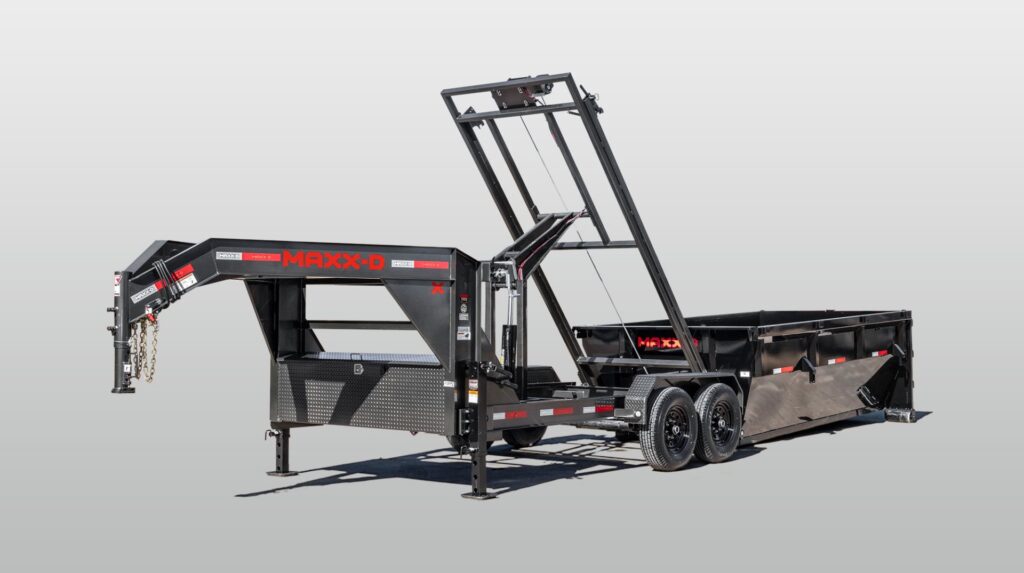
A roll-off uses a scissor hoist and a heavy-duty winch instead of the straight-ram cylinder on a standard dump. To drop a bin, the hoist tilts the frame and the bin rolls off the back on built-in rails. To load one, the winch pulls it up those same rails until it sits flat. Here is what the Maxx-D ROX brings to that job:
- 45-degree dump angle from a heavy-duty scissor lift and hydraulic hoist, so loads clear the bin cleanly.
- 22K Warrior power winch, built to load and unload bins all day.
- Drop-and-swap workflow, so one trailer keeps several bins working across job sites.
Maxx-D Roll-Off Models and Specs
Maxx-D builds its roll-off line around the ROX, with heavier RPX and RSX models when you need more capacity. All come in bumper-pull or gooseneck, and all take 4-foot and 6-foot bins.
| Model | GVWR | Pull type | Bins | Best for |
|---|---|---|---|---|
| ROX 14K | 14,000 to 17,500 lb | Bumper-pull or gooseneck | 4 ft and 6 ft | Dumpster rental, contractors serving a few sites |
| RPX | 17,500 to 21,000 lb (about 19,000 lb standard) | Bumper-pull or gooseneck | Bins up to roughly 16 to 21 cubic yards | Heavier debris and higher-volume routes |
| RSX 21K | 21,000 lb | Bumper-pull or gooseneck | 4 ft and 6 ft | Daily commercial roll-off operations |
One note on specs: exact bed length, axle rating, and bin volume vary by build. Check the spec sheet on the specific unit before you buy, or ask us and we will pull it for you.
See the ROX work through a full drop-and-load cycle:
Big Tex and Horizon Roll-Offs
We also stock roll-offs from Big Tex (14RB bumper-pull, 14RD gooseneck) and Horizon (RDZ bumper-pull, HRD gooseneck). They run a comparable winch-and-rail setup in the 14,500 to 16,000 pound GVWR range. If you already run one of these brands and want to match your fleet, we can source them.
Bins: Buy One, or Buy a Package
Bins are sold separately from the trailer, which is the whole point of the system. Two common ways to buy:
- Trailer plus one bin. The starter setup. Fine if you run a single site at a time.
- Trailer plus three bins. The popular fleet setup, and you usually get a package discount when you buy three bins at once. Drop bins at three sites and run one trailer between them.

Bins come with 4-foot or 6-foot sides on a 10-gauge steel floor. A 6-foot bin holds more volume for light, bulky debris. A 4-foot bin keeps heavy material lower so you stay under weight.
Sizing a Bin to Your Loads
Match the bin to what you actually haul most weeks:
- Heavy, dense debris like concrete, demolition, and dirt: you hit the trailer's GVWR before the bin looks full. A 4-foot bin keeps you legal.
- Light, bulky material like cleanouts, landscaping, and roofing tear-off: you fill the bin's volume before you reach the weight limit. A 6-foot bin earns its keep.
- A mix of both: talk through real job examples with us rather than guessing from a spec sheet.
Matching GVWR to Your Tow Vehicle
A loaded roll-off, bin and debris included, has to stay within both its own GVWR and your truck's tow rating. A 14K to 16K bumper-pull needs a properly equipped three-quarter-ton or one-ton truck. A 21K gooseneck needs a one-ton with a gooseneck hitch. Check your truck’s rated tow capacity against the trailer's fully loaded weight, not its empty weight. With a roll-off, "fully loaded" means the bin plus everything in it.
Financing and Rent-to-Own
NC Trailers carries the Maxx-D, Big Tex, and Horizon roll-off lineups at our Thomasville and Winston-Salem lots, and we can finance the trailer and bins together or separately. Rent-to-own is available on qualifying roll-off trailers if you would rather spread the cost out than pay it all upfront.
Need more info?
 About the Author