


Drop Deck Trailer vs. Equipment Trailer: When the Low Profile Matters
An Air-Tow drop deck trailer and a standard equipment trailer both move wheeled or tracked equipment from one site to another, but they load very differently. People often assume the choice comes down to weight. It usually does not. Most of the time the deciding factors are how wide your load is, how long it is, and what you want to spend.
NC Trailers carries Air-Tow drop deck trailers alongside equipment trailers from Maxx-D, Big Tex, Horizon, RawMaxx, Nolan, and Superior at our Thomasville and Winston-Salem locations. Air-Tow draws a specific kind of buyer: someone with equipment that is slow, low, or awkward to load up a ramp, or a one-person crew that needs to load and unload without a second set of hands. Here is how the two trailer types differ and how to tell which one your work needs.
The Core Difference: How the Deck Gets Low
A standard equipment trailer loads over ramps that bridge the ground and a fixed-height deck. The loading angle comes down to how tall the deck is and how long the ramps are. That works fine for most equipment, but it becomes a problem for a machine with low ground clearance, small wheels, or poor traction.
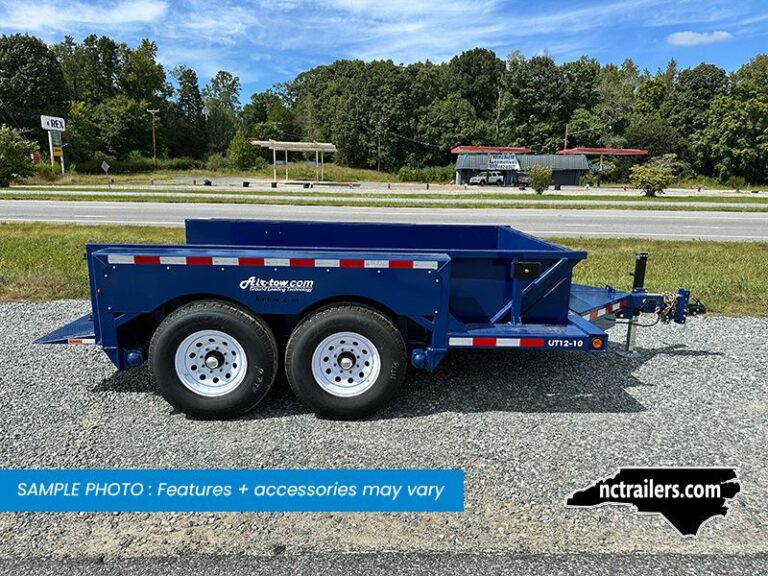
The Air-Tow flatbed uses a different idea. The deck stays completely level while it raises and lowers hydraulically in less than 30 seconds. At ground level you simply drive your equipment onto the trailer, then raise the deck to transport height. There is no ramp angle to climb and no transition for a low machine to high-center on. It is especially useful for equipment with poor traction or low ground clearance such as scissor lifts, sweepers, and pavement rollers. Air-Tow eliminates tilt beds and loading ramps, which makes it a one-person job even in bad weather.
Side-by-Side Comparison
| Feature | Air-Tow Drop Deck | Standard Equipment Trailer |
|---|---|---|
| Loading method | Hydraulic deck lowers level to the ground in under 30 seconds, no ramps | Tilt deck, fold-down ramps, mega ramps, or slide-in ramps |
| Loading surface | Drive on at ground level, deck stays flat | Climb a ramp to a fixed-height deck |
| GVWR range | 5,240 to 18,780 lbs | About 7,000 to 21,000 lbs |
| Max payload | Up to 14,000 lbs | Varies by model, higher-capacity configs available |
| Deck width | Up to 75 inches (6 ft 3 in) | 72 to 82 inches, up to a full 102 inches with drive-over fenders or a deck-over |
| Deck length | Up to 16 ft | Commonly up to 24 ft, longer available |
| Tow vehicle | Half-ton to one-ton depending on size | Half-ton on the small end, one-ton or larger on the big end |
| Typical price | $12K to $30K (enclosed or refrigerated $40K to $80K) | $5K to $25K |
| Best for | Low, poor-traction, or pallet-loaded loads; one-person loading | Wider and longer loads, heavier configs, lower budget |
Width, Length, and Budget Usually Decide It, Not Weight
The two trailer types overlap on weight. An Air-Tow runs from a 5,240-lb GVWR up to 18,780 lbs, which leaves room for up to 14,000 lbs of payload once you subtract the trailer's own weight. Equipment trailers commonly run from about 7,000 lbs GVWR up to 21,000 lbs, and you can order them heavier. So a lot of loads will physically ride on either one.
What separates them is shape and cost. An Air-Tow maxes out at 75 inches wide and 16 feet long, so a wide or long load points you toward an equipment trailer. An equipment trailer is also the cheaper way to move a machine that can handle a ramp. The Air-Tow earns its higher price when the load is hard to load any other way: low ground clearance, small wheels, poor traction, or something that has to be set on the deck with a pallet jack rather than driven on.
What Loads Well on Each Trailer Type
| Load | Air-Tow Drop Deck | Standard Equipment Trailer |
|---|---|---|
| Scissor lift | Ideal, level deck handles low clearance and poor traction | Ramp angle and traction can be a problem |
| Smooth drum compactor or roller | Ideal, loads flat at ground level | Difficult and risky on ramps |
| Sweeper | Yes, no traction issue at ground level | Ramp traction can be a problem |
| Most skid steers and mini excavators | Yes, within deck width and length | Yes, standard choice for larger models |
| Pallet-loaded items (vending machines, safes, pallet material) | Yes, set on the deck with a pallet jack or hand truck | Not practical |
| Zero-turn mower or compact tractor | Yes, easy one-person load | Yes, common landscape use |
| Wide or long equipment, full-size machines | Check the 75-inch width and 16-ft length first | Better suited, wider and longer options |
How Equipment Trailers Are Built
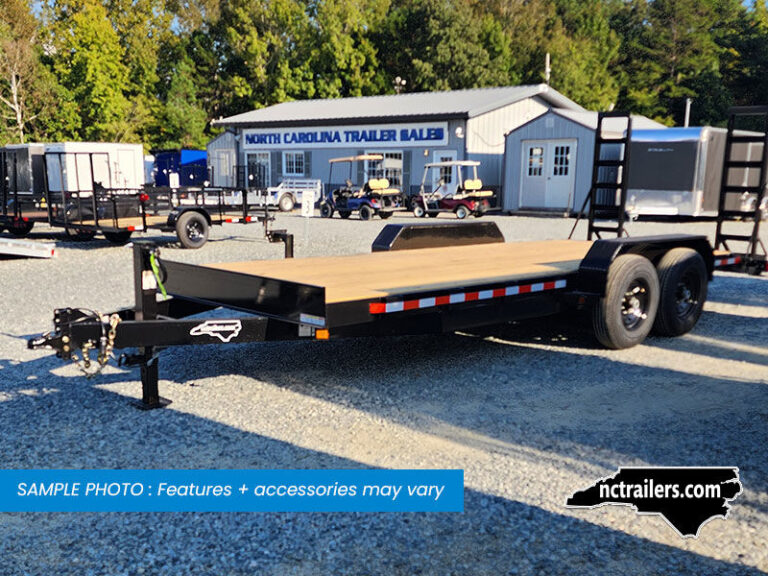
Equipment trailers load a few different ways. You can get a single-axle tilt deck, fold-down ramps, spring-assisted mega ramps that lay flat to extend the deck and run the full width, or slide-in ramps. That range lets you match the ramp to the equipment instead of the other way around.
Sizes run from a single-axle tilt at 7,000 lbs GVWR, 13 feet long and 72 inches wide, up to an 82-inch-wide, 24-foot trailer at 21,000 lbs GVWR. You can go longer and heavier, but that band covers most jobs. To get a full 102 inches of deck width you have two options: drive-over fenders, or a deck-over design that sets the deck above the wheels. A deck-over gives you a flat 102-inch surface, but the deck sits about 32 to 35 inches tall. That raises the loading angle and lowers how tall a load you can carry, since the whole rig still has to stay under the 13.5-foot legal height limit.
What an Air-Tow Is Built For
Air-Tow is built around the one-person load. The level hydraulic deck means no ramp to position, no transition angle to fight, and no helper needed to guide a machine up a slope. For a crew loading and unloading at site after site all day, the time saved on every stop adds up. For equipment that is dangerous or impossible to load on a ramp, the level deck is the whole reason to own one.
Within its 75-inch width and 16-foot length, an Air-Tow handles most skid steers, mini excavators, scissor lifts, rollers, sweepers, and anything you would rather set down with a pallet jack than drive up a ramp. If your load fits that envelope and is awkward to load, the Air-Tow pays for itself in saved time and avoided risk.
Pricing and Financing
Equipment trailers commonly run from about $5,000 to $25,000 depending on size, capacity, and ramp setup. Air-Tow flatbeds typically run from about $12,000 to $30,000, and Air-Tow enclosed or refrigerated models can run $40,000 to $80,000. Both trailer types can be financed at our Thomasville and Winston-Salem locations. If you are buying either one for business use, ask about Section 179, which can allow a full first-year deduction on a business-use trailer. Confirm the details with your CPA, since how much you can write off depends on your tax situation.
See What's in Stock
Browse the equipment trailer inventory for current Maxx-D, Big Tex, Horizon, RawMaxx, Nolan, and Superior units, and the Air-Tow inventory for level-load drop deck configurations in stock. To start financing or review terms, visit the trailer financing page. If you want to compare an Air-Tow against an equipment trailer in person, either location carries both, and the team can walk through your specific load and how you work before you decide.
Still deciding between a drop deck and an equipment trailer?
Call us, stop by either lot, or fill out the financing request just below and we will get right back to you.
 About the Author