
The first thing you notice about a flatbed is what is not there. No walls, no roof, no door to work a load through, and no interior height to plan around. A forklift can set a pallet anywhere on the deck, a crane can drop a load straight down onto it, and a length of pipe can run past the back of the deck if you flag it properly. That is why open deck trailers still do the work on job sites where an enclosed box would just get in the way. NC Trailers sells open deck trailers out of Thomasville and Winston-Salem, and here is how they compare to the other styles on the lot.
What Sets a Flatbed Apart from a Drop Deck or Enclosed Trailer
A flatbed is a single flat platform, one height front to back, with no sides and no roof. That makes it the simplest trailer on the lot to load. It also means the whole deck sits at one height off the ground, so your load angle is whatever that height gives you. A drop deck, sometimes called a step deck, lowers part of the platform closer to the ground so taller equipment clears height limits and rolls on at a shallower angle. We stock drop deck trailers too, and if you are weighing the two, our post on drop deck trailers and equipment trailers goes deeper. An enclosed trailer wraps everything in walls and a roof, which keeps weather and thieves off your cargo but takes away the ability to load from the top or the side.
Deck Width: Deckover vs. Between the Fenders
Open decks come two ways, and the difference is worth knowing before you buy. A deckover trailer runs the deck over the top of the tires at 102 inches wide, which is the legal maximum without a permit. You get full width edge to edge, but the deck sits higher, so your load angle is steeper unless the trailer has a tilt or a dovetail. A fender style trailer puts the deck down between the tires, usually 82 to 83 inches of usable width. It rides lower and loads at a shallower angle, but you are working around the fenders.
Loading Without Walls or a Roof
With nothing overhead or to the sides, you can load from any direction with a forklift, a crane, or a dock set at deck height. That matters most for freight that is long, wide, or shaped wrong for a doorway. The tradeoff is that your load is out in the weather and exposed to road debris, so tarping and strapping carry more weight on a flatbed than on anything with a roof.
Common Loads a Flatbed Trailer Is Built to Haul
Flatbeds earn their keep on freight that will not go through a door. Lumber, structural steel, PVC and metal pipe all load from the side and can run past the deck length when they need to. Palletized freight, roofing material, block, stone, and bagged landscape supply all move fast on an open deck when a forklift is doing the work.
Lumber, Pipe, and Palletized Freight
Long rigid material needs enough deck under it to support the load evenly. Unsupported overhang flexes and shifts once you are rolling. Palletized freight likes a flat obstruction-free surface where a forklift can set pallets down anywhere instead of working around wheel wells and side rails, which is another point for a deckover.
Equipment and Machinery
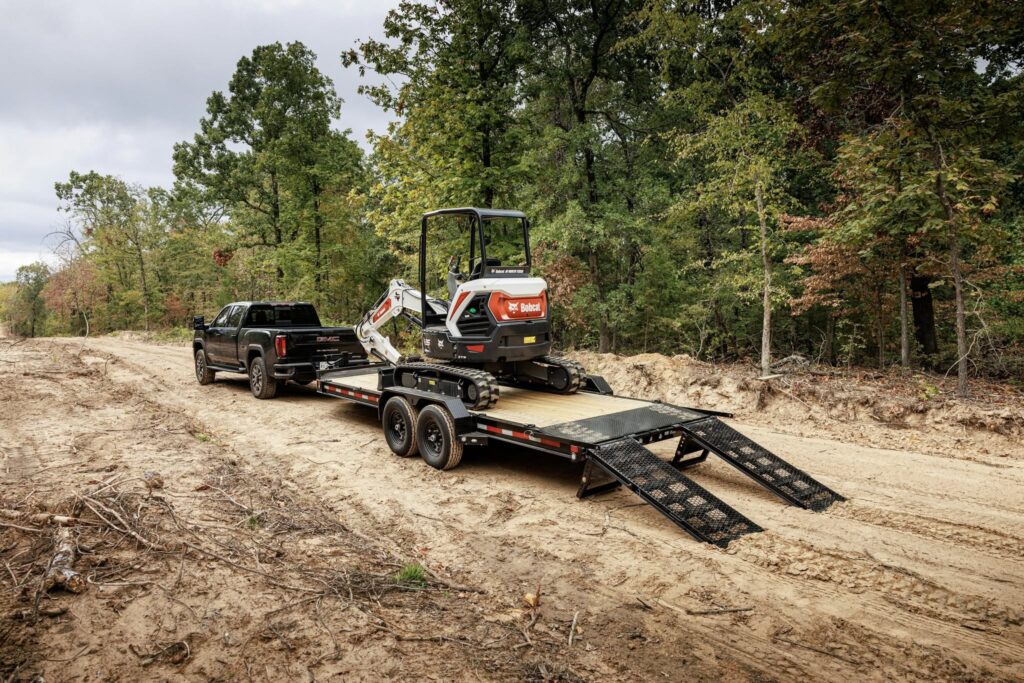
Contractors and landscapers run flatbeds for machines short enough that ramp clearance is not a problem, like a small skid steer, a compact tractor, or attachments hauled separately from the machine that runs them. For taller equipment, a drop deck or equipment trailer is the better tool.
One thing people get wrong: an open deck is not drive-on only. Plenty of our customers never roll anything onto theirs. They set palletized material on with a forklift and haul it that way, and the same trailer does both jobs.
Deck Material and Load-Securing Options
Most open decks you will see are 2-inch treated wood. It is the standard for a reason. It grips pallets and equipment tires, it is cheap to replace a board, and it takes abuse. On the really heavy duty trailers you will find oak, which is denser and holds up better under steel tracks and point loading. Steel decking is available on some models and resists denting, but it adds weight that comes straight out of your payload.
| Deck Material | Where You See It | What to Know |
|---|---|---|
| 2" treated wood | The standard on most open decks | Good traction, cheap to repair a board, check for rot and loose boards on trailers that live outside |
| Oak | Heavy duty trailers | Denser than pine, better under steel tracks and concentrated point loads |
| Steel | Available on some models | Shrugs off dents and sharp-edged freight, but the added weight cuts into payload |
Tie-Down Points and Securement Basics
Every open deck should give you enough stake pockets, D-rings, or rub rail to anchor tie-downs across the full length of the load, not just at the ends. The principle is simple and it applies whether or not you fall under federal rules: the load has to be secured so it cannot shift, spill, or come off the trailer while you are moving. Multiple anchor points, spaced evenly, working against every direction the load could travel. If you haul commercially, check the current federal cargo securement rules for your load type, because they get specific about working load limits and how many tie-downs a load needs by length and weight.
Weight Capacity Ranges by Axle Configuration
Open decks come single axle and tandem axle. A single axle is lighter, easier to move around by hand, and enough for smaller loads of lumber, landscape material, or light equipment. A tandem spreads the load across two axles, which raises GVWR and settles the trailer down when you are loaded heavy or the weight is not sitting evenly.
Single Axle vs. Tandem Axle
Single axle suits lighter and more occasional hauling. Tandem is what contractors moving weight on a schedule end up with, and the second axle also gives you more brake and less sway at highway speed when you are loaded near capacity. Open deck trailers on our lot run from about 7,000 lb GVWR up to 21,000 lb, so read the certification label on the specific unit rather than guessing from the axle count.
Matching GVWR to Your Tow Vehicle
Check your truck's rated towing capacity against the trailer's GVWR plus a full load, not the trailer's empty weight. Also check payload, because tongue weight lands on your truck's rear axle and counts against payload rather than towing. A trailer that outweighs what your truck is rated to pull puts real strain on the frame, brakes, and hitch, and it can become an insurance problem if something happens while you are over.
Federal Inspections on Commercial Open Decks
If you use the trailer for business and it has a GVWR over 10,000 lb, or you cross a state line with it for work, it needs an annual federal safety inspection. Most open decks past a light single axle clear 10,000 lb, so plan on it. The trailer has to pass its own inspection even if your truck is already compliant, and the sticker goes on the tongue. We do these at both locations.
When an Open Flatbed Beats an Enclosed Trailer
An enclosed trailer is the right call when cargo needs to stay dry or locked up, but it adds weight and limits how freight gets on and off. A flatbed wins any time the job calls for top-loading with a crane or forklift, hauling material that runs past standard trailer length, or moving something too tall or too wide to fit through a door. Job sites running quick load and unload cycles benefit too, because nobody is backing a forklift through a doorway or working around interior walls.
Finding the Right Flatbed Trailer at NC Trailers
If you have been hauling oversized loads in a pickup bed or borrowing a trailer that is not quite right, a properly sized open deck ends the guesswork. We carry Nolan, Maxx-D, RawMaxx, Southland, Superior Trailers of GA, and Air-Tow open deck models, and Nolan is the volume brand on our equipment lot. On payment: we work with over 20 lenders and we accept all credit types. Most buyers go through traditional trailer financing, and for anyone who cannot, our rent-to-own program is the no credit check path, so there is a way to pay for it either way. Come see them in Thomasville or Winston-Salem, or browse the open deck and drop deck inventory online.
Not sure which open deck fits your load?
Call us, stop by either lot, or fill out the financing request just below and we will get right back to you.
 About the Author