

Trailer breakaway systems: how they work, how to test one, and where the cable goes
If a trailer with electric brakes ever comes off the hitch, the breakaway system is the only thing that can stop it. It is a small battery, a switch and a pull cable, and it is easy to forget about once the trailer is home. This page covers what each part does, how to check it before you tow, and the hookup mistake that defeats the whole system.
The instructions below come from the manufacturers' own documents, mainly Dexter's installation sheet for its Trailer Parts Pro breakaway kits and Dexter's axle service manual. They are listed at the bottom of the page.
What a breakaway system is
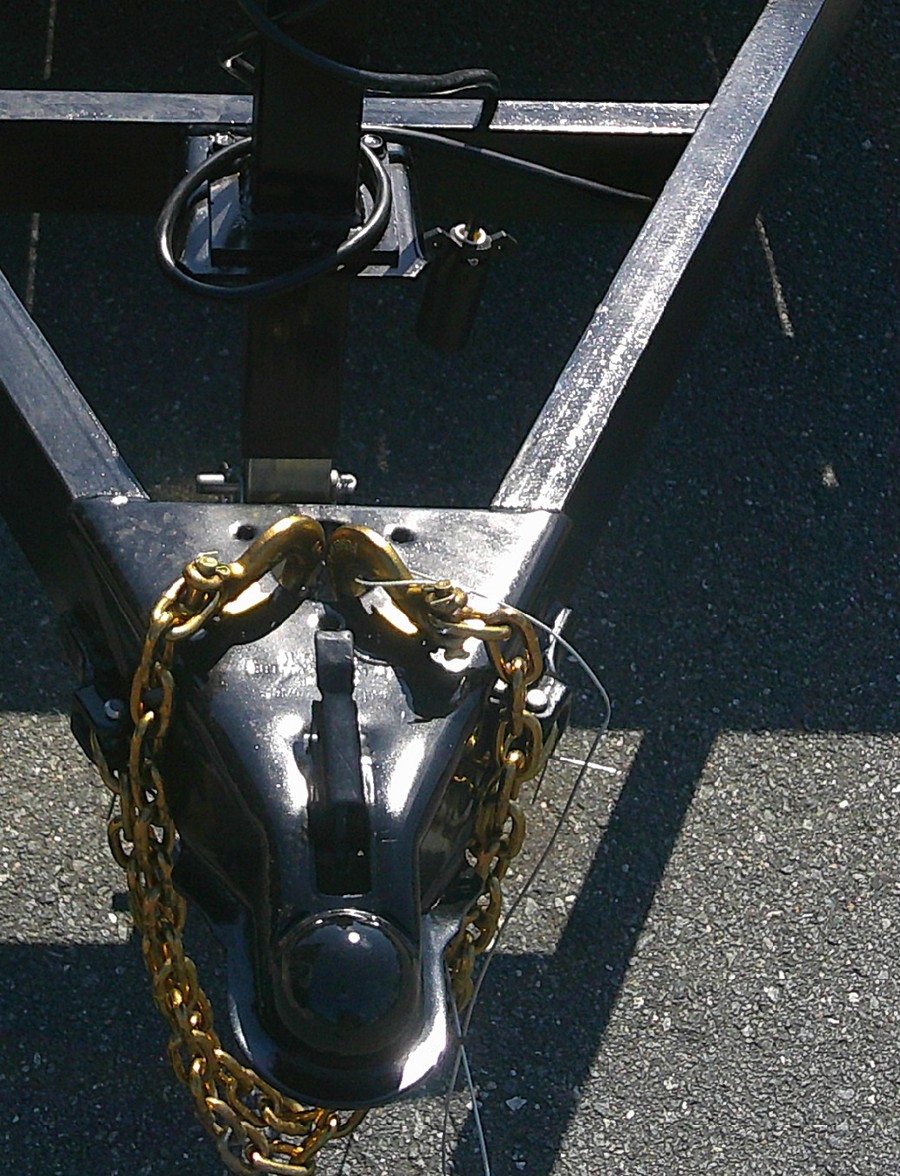
There are three parts, and Dexter's manual describes each one in a line:
- The breakaway battery provides power to apply the trailer brakes if the trailer breaks away.
- The breakaway switch is mounted on the tongue. It holds a pin on the end of a cable, and when that pin is pulled out, the switch sends battery power to the brakes.
- The charger tops the battery up from your truck's 7-way plug while you tow, through the 12-volt auxiliary circuit.
The cable clips to the truck. If the trailer separates, the cable pulls the pin, the battery powers the brakes, and the trailer stops instead of rolling on by itself.
It only works on trailers with electric brakes, and it is not a parking brake. Both Dexter and CURT say plainly not to use a breakaway kit to hold a parked trailer.
The hookup mistake: do not clip it to the safety chains
This is the one to get right. Every kit instruction we checked says the same thing: do not attach the breakaway cable to the safety chains, the mounting hooks or the trailer ball. Attach it to the tow vehicle itself, usually the safety chain mount on the hitch or a loop made for the breakaway pin.
The reason is simple once you picture a breakaway. The safety chains are part of the trailer. If the trailer gets loose from them, a cable clipped to the chains goes along with it and never pulls the pin. Looped over the ball, the cable can simply bounce off while you drive, which Dexter's sheet warns about. The cable has to be anchored to the truck itself so that it stays behind and pulls the pin.
A few more placement rules from Dexter's sheet:
- Give the cable just enough slack to reach the truck when the trailer is hitched, but not so much that it drags or snags.
- Make sure you can turn hard left and hard right without the cable pulling tight.
- Do not loop the cable over the hitch ball. It can bounce off while you drive.
- Keep it clear of sharp edges where it could get pinched or cut.
How to test it
Dexter's maintenance schedule lists the breakaway system under "at every use": check the battery charge and check that the switch works. That is two quick checks, and both can be done in the driveway.
1. Check the battery. Most kits have a push-to-test button on the battery box. Unplug the trailer from the truck first, because Dexter and CURT both warn that pressing the test button with the 7-way connected can damage the system. On Dexter's push-to-test box, a green light when you hold the button means the battery is charged, and a red light means it needs charging.
2. Check the switch. With the trailer unplugged from the truck, pull firmly on the cable. The pin comes out and the battery should apply the brakes. Push the pin back in until it is flush with the switch body and the brakes release.
The full shop test goes one step further. With the trailer safely up on jack stands, spin a wheel and pull the pin. The wheel should stop at once. The kit instructions have you leave the pin out for 15 minutes and then try the wheels again. They should still be locked. Recharge the battery afterward, because a test like that drains it.
Always unplug the trailer from the truck before any breakaway test. CURT warns that testing while connected can badly damage the truck's electric brake controller.
Keeping the battery charged
If the red light comes on, Dexter's sheet says to plug the trailer into the truck, start the truck and let it run 10 to 15 minutes. Then shut it off, unplug, wait two minutes and hold the test button for five seconds. You should get green.
Towing regularly keeps the battery topped up on its own. If the trailer is going to sit for a long stretch, Dexter recommends taking the battery out and putting it on a battery maintainer. Both manufacturers put average battery life on a full charge at 9 to 12 months without maintenance charging, so a trailer that sits through the winter should get a test before its first trip in the spring.
The charger can only work if your truck's 7-way plug is actually sending 12 volts on the auxiliary circuit. If your battery keeps going flat even though you tow often, have the truck side checked.
How the wiring goes together
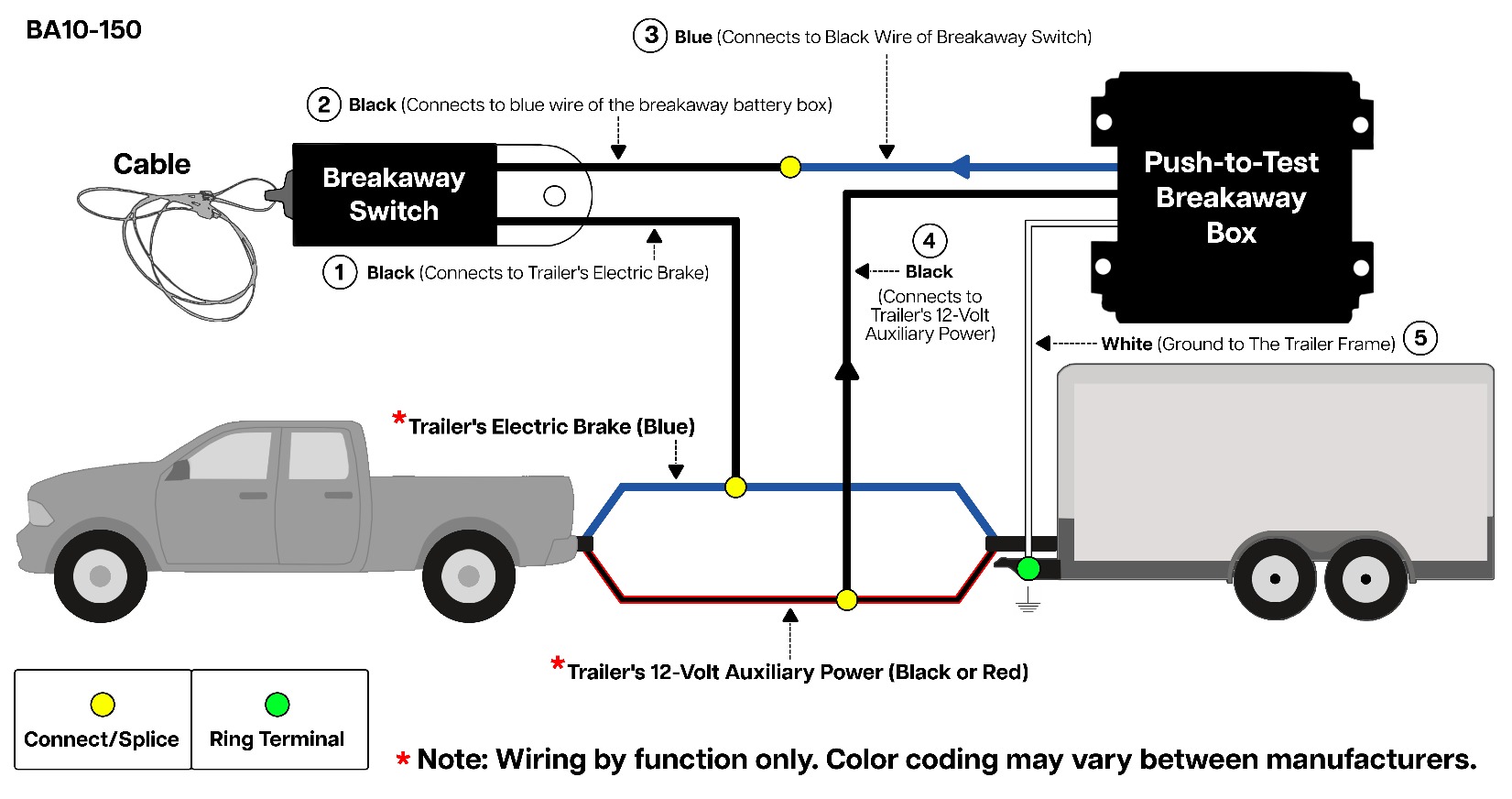
You do not need to wire one to use one, but the diagram shows why the two tests above cover the whole system. The battery box feeds the switch, and the switch feeds the same brake wire your controller uses. If the battery is charged and the switch applies the brakes, the circuit is doing its job. Dexter's sheet also asks you to check the wiring and switch before each trip, because an open or shorted wire can leave you with no breakaway braking at all.
Is a breakaway system required?
North Carolina's brake statute, G.S. 20-124, requires brakes on a trailer with a gross weight of two tons but does not mention breakaway systems. The federal motor carrier rule, 49 CFR 393.43(d), does: every trailer required to have brakes must have brakes that apply automatically and immediately on breakaway, and they must stay applied for at least 15 minutes. That is where the 15-minute shop test comes from.
We cover the state rules in more detail on our North Carolina trailer laws page. The practical answer is the same whichever rule applies to you: if your trailer has electric brakes, keep the breakaway system working.
Want us to check yours?
A dead breakaway battery gives no warning until the day you need it. Bring the trailer by and our service team will test the battery, the switch and the brakes it is wired to.
Thomasville: (336) 276-0329
Winston-Salem: (336) 499-9888
Rather type than talk? Send us a message and we will set up a time.
Related guides
- Understanding trailer brake systems and when to service them, the brakes the breakaway kit is wired to.
- Trailer brake controller guide, for the controller in the cab.
- Pre-trip towing inspection checklist, where the breakaway check belongs.
- North Carolina trailer laws, size, weight, brakes and inspection.
- How to repack trailer wheel bearings, the other job that gets skipped.
- Trailer service at NC Trailers.
Sources
- Dexter, Trailer Parts Pro Breakaway Kit Installation Instructions (BA10-140 and BA10-150), for cable placement, testing, charging, storage and the wiring diagram.
- Dexter, Operation Maintenance Service Manual, 600 to 8,000 lb axles (LIT-001-00), for the component descriptions and the "at every use" maintenance schedule.
- CURT, Breakaway kit 52044 installation manual, for the controller-damage warning and the parking-brake caution.
- 49 CFR 393.43, and North Carolina G.S. 20-124(f).