

North Carolina Trailer Laws
Most trailer rules in North Carolina come down to a handful of numbers: 102 inches, 14 feet, 60 feet, and 4,000 pounds. This page collects the ones that actually apply to the trailers people tow every day, with the statute behind each one so you can check it yourself.
Everything below is North Carolina General Statutes, Chapter 20, and every rule links to the statute it came from. If your situation is unusual, or you are hauling commercially, confirm with the NC DMV before you rely on a summary.
The short version, in 82 seconds. Every number below is cited to the statute it came from.
Every number on this page is North Carolina law, and several are not the national standard. Most trailers cross a state line eventually, so wherever the two differ you will find a side-by-side box under the rule.
Watch for the ones marked stricter. Those are the numbers to actually plan around, because meeting North Carolina is not always enough — the brake rule and the height limit are both cases where the rest of the country asks for more than this state does.
How big can your trailer be?
Width: 102 inches
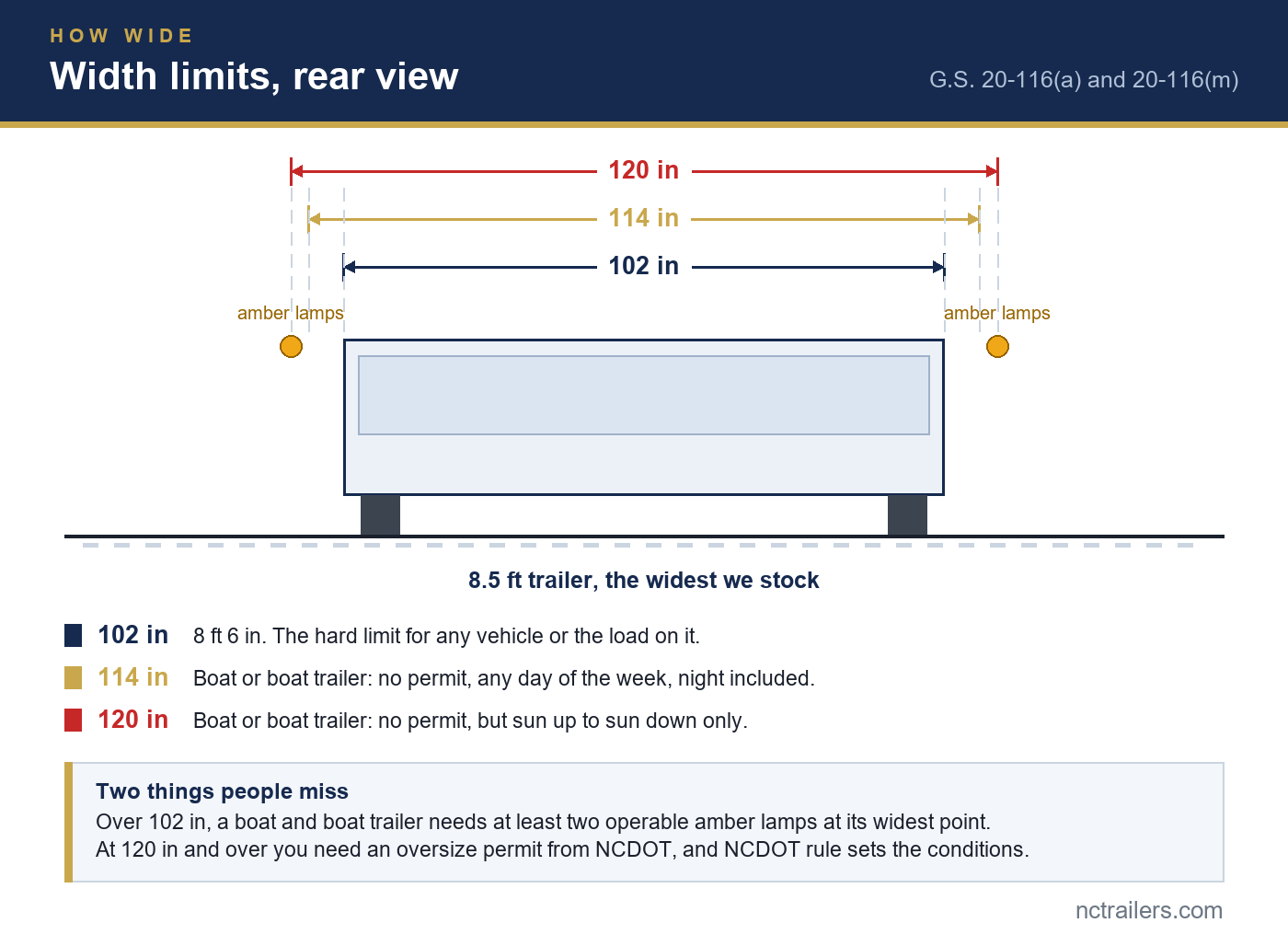
The total outside width of any vehicle, or the load on it, cannot exceed 102 inches. That is 8 feet 6 inches, and it is the reason the widest trailers on our lot are 8.5 feet.
It is also why the load matters as much as the trailer. An 8.5-foot deck with lumber hanging over the side puts you over the limit even though the trailer itself is perfectly legal.
Source: G.S. 20-116(a)
102 inches is also the federal standard for the National Network (23 CFR 658.15), and effectively every state matches it. A trailer built to 8 ft 6 in is legal on width wherever you take it — which is exactly why almost nothing is built wider.
The boat trailer exception
Boats are the big carve-out, and the rules are more generous than most people realize. A boat or boat trailer under 120 inches wide may be towed without a permit. The conditions scale with width:
| Width | Permit | When you may tow | Lighting |
|---|---|---|---|
| 102 in or less | None | Any time | Not required |
| 102 to 114 in | None | Any day of the week, night included | Two operable amber lamps |
| 114 to 120 in | None | Any day of the week, sun up to sun down | Two operable amber lamps |
| 120 in or more | Oversize permit from NCDOT | Set by NCDOT permit rule | Two operable amber lamps |
Source: G.S. 20-116(m)
The 120-inch allowance is North Carolina’s own and it does not travel with you. Cross a line and you are back to the 102-inch standard unless that state has its own boat provision, and going over it means an over-width permit and route restrictions.
The tobacco exception
Worth knowing if you farm. Hauling hogsheads of tobacco gets a six-inch tolerance. Sheet or bale tobacco may run up to 114 inches at the top of the load, as long as the bottom of the load at the truck bed stays within 102 inches after any shifting or settling.
Source: G.S. 20-116(a)
The tobacco tolerance is written into North Carolina law for North Carolina farm hauling. It is not a national allowance, and 114 inches is over the 102-inch standard every neighbouring state applies. Treat it as a rule for moving a crop inside this state, not as travelling permission.
Height: 14 feet, but plan around 12 feet 6 inches
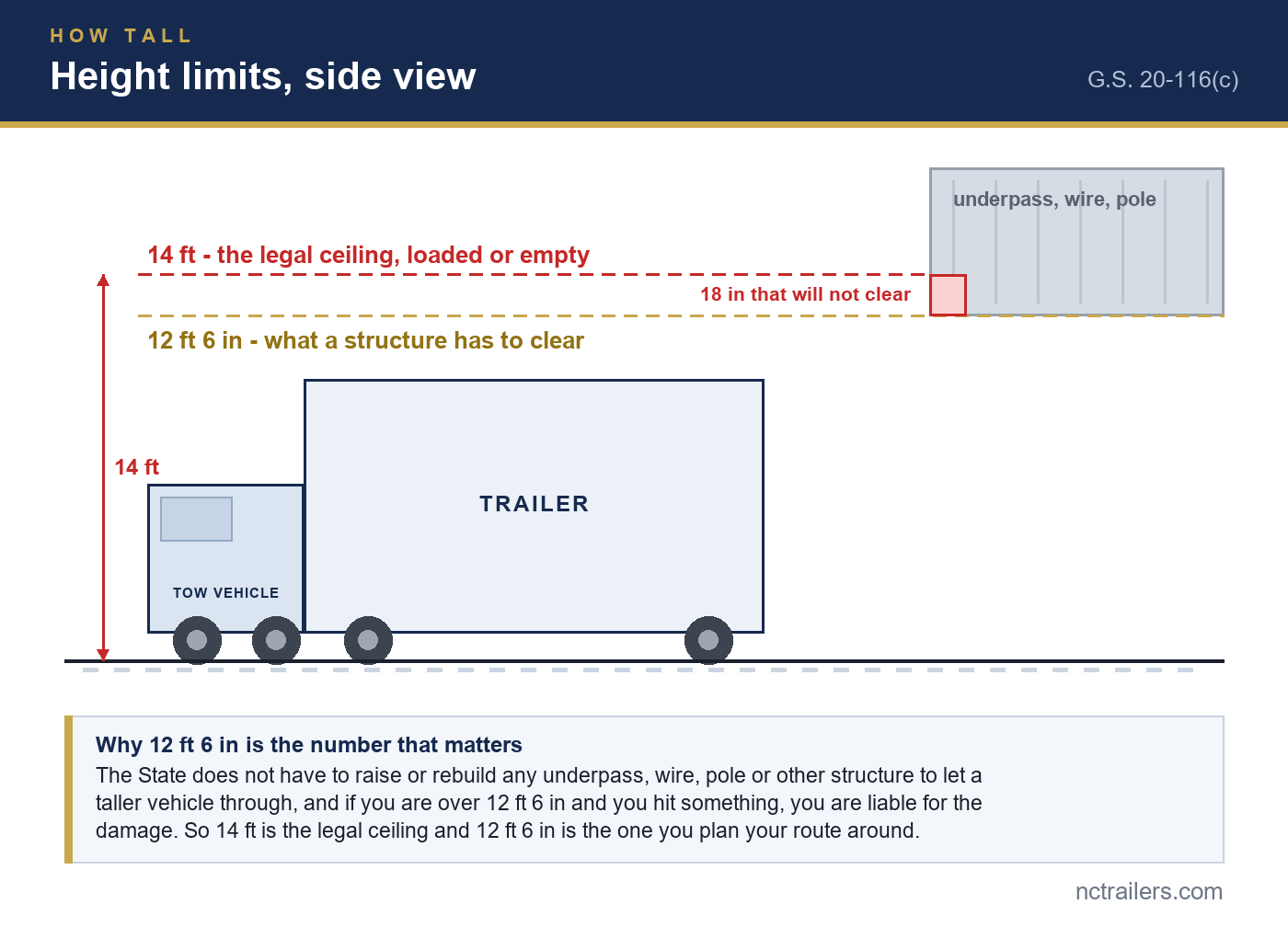
No vehicle, loaded or empty, may exceed a height of 14 feet. There is a catch in the same statute that catches people out.
North Carolina is not required to raise or rebuild any underpass, wire, pole, or other structure to let a vehicle over 12 feet 6 inches through. And if you are taller than 12 feet 6 inches and you hit something, you are liable for the damage.
So which number do you use?
14 feet is the legal ceiling. 12 feet 6 inches is the practical one. Anywhere above that height you are responsible for routing yourself around whatever the road throws at you.
Source: G.S. 20-116(c)
Fourteen feet is on the tall end nationally. South Carolina and Virginia both stop at 13 ft 6 in, which is the far more common figure. A load that is perfectly legal at 14 feet in North Carolina is over the limit the moment you cross into either one.
And the 12 ft 6 in structure-clearance line still applies the whole time you are in this state, whatever your height.
Length: 40 feet single, 60 feet combined, two units maximum
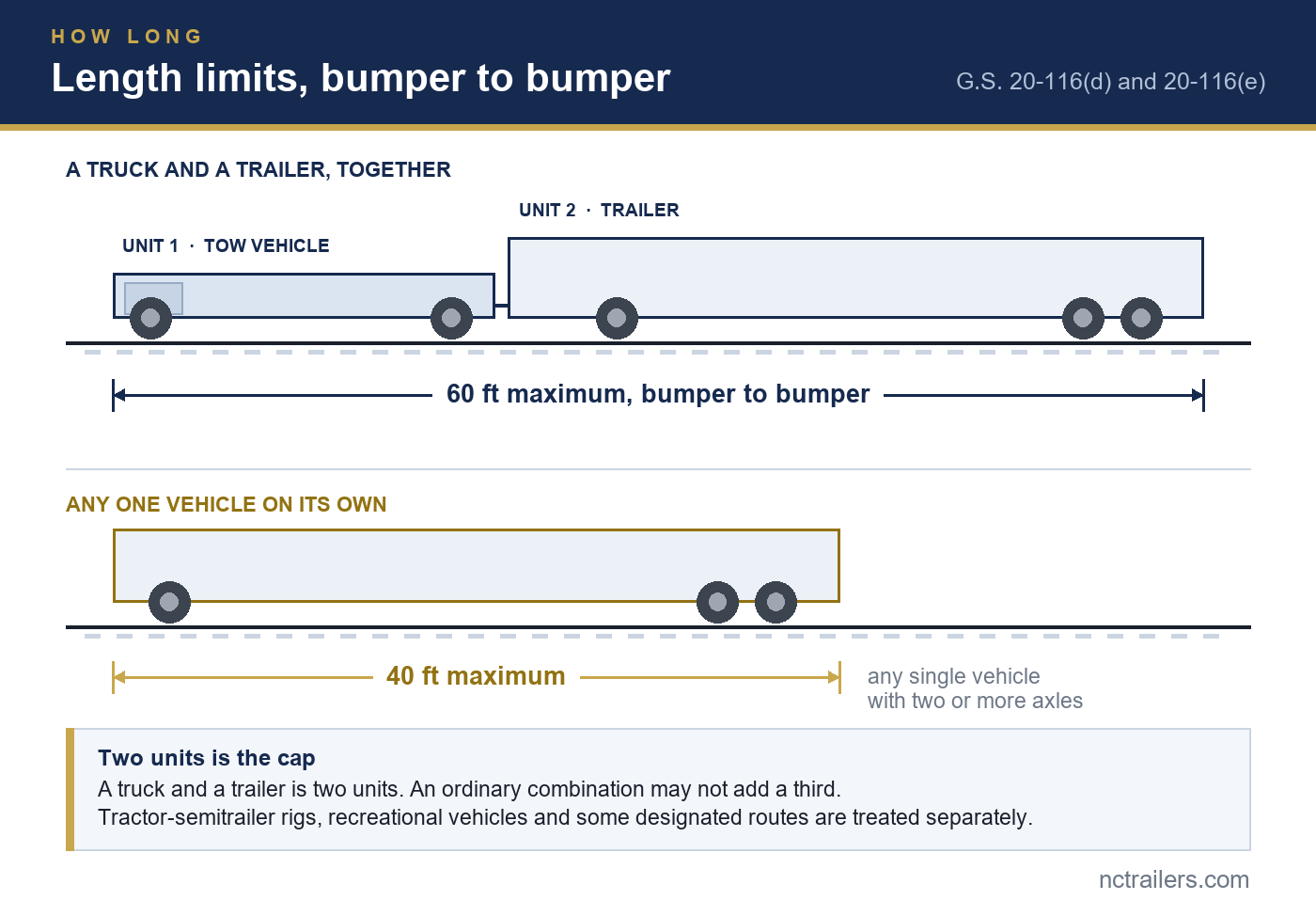
A single vehicle with two or more axles cannot exceed 40 feet overall.
For a truck and trailer together, two limits apply at once. The combination cannot be more than two units, and the whole thing cannot exceed 60 feet including front and rear bumpers.
Longer semitrailer combinations get an exception, recreational vehicles get their own 45-foot limit, and so do some designated routes. Those rules sit in the same statute and in G.S. 20-115.1.
Source: G.S. 20-116(d) and 20-116(e)
This rule runs the opposite way from the height rule. Sixty feet and a two-unit maximum are tighter than several neighboring states — Virginia allows 65 feet. So a combination that is perfectly legal where it was bought can be over length once it gets here.
The 4,000 pound line
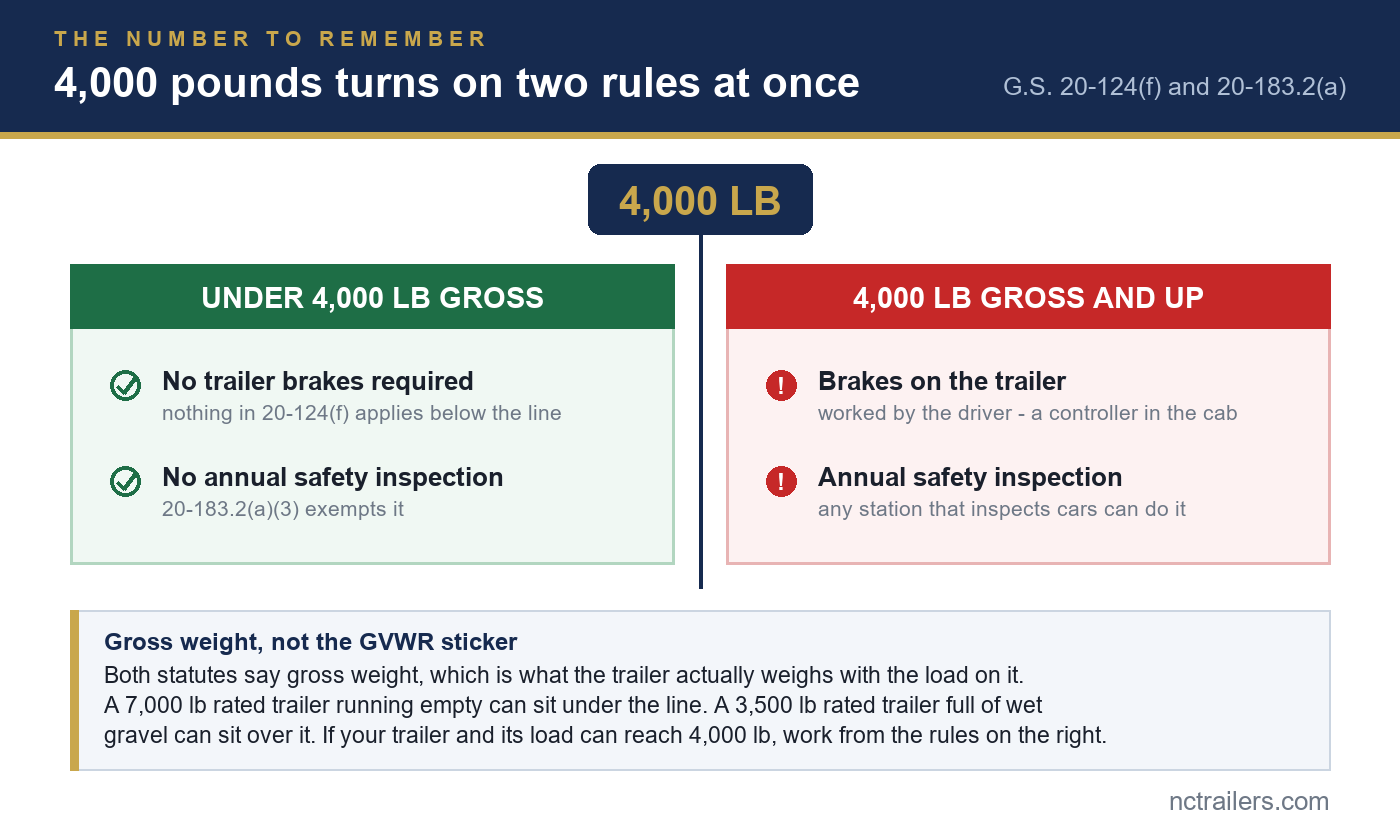
If you remember one number from this page, make it this one. Four thousand pounds is where two separate legal requirements switch on at the same time. We had not seen those two rules connected anywhere, including on our own site, until we went back to the statute text.
1. Your trailer needs its own brakes
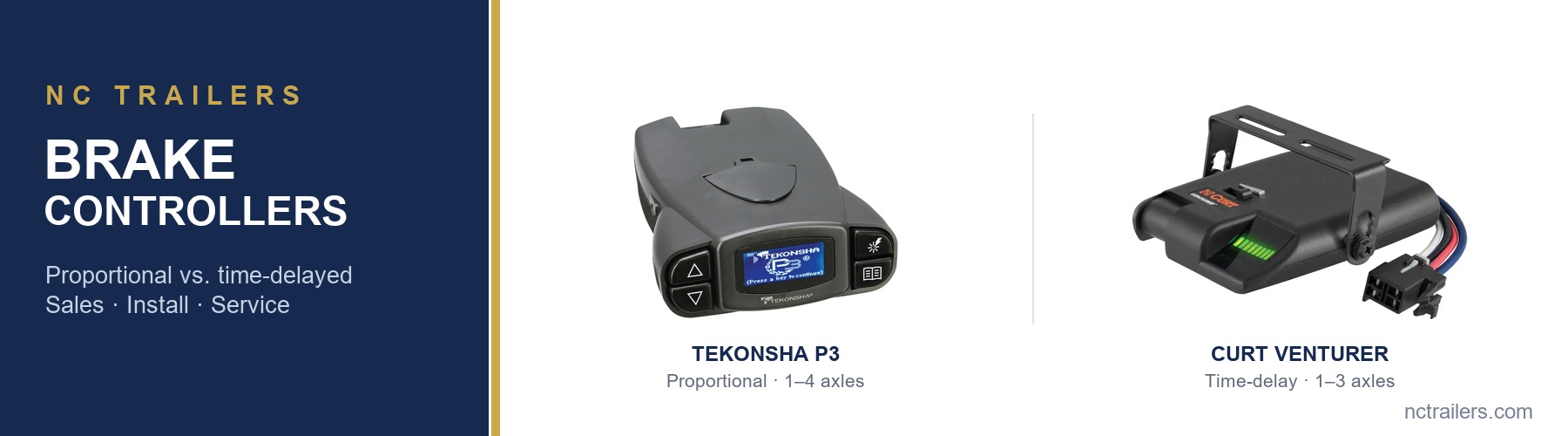
North Carolina requires brakes on any trailer or semitrailer attached by a drawbar or coupling to a towing vehicle and having a gross weight of two tons. Two tons is 4,000 pounds. Those brakes have to be operated by the driver of the towing vehicle, which in practice means a brake controller in the cab.
Read the wording carefully
The statute says gross weight, which is what the trailer actually weighs with the load on it, not the GVWR rating stamped on the frame. A 7,000-pound-rated trailer sitting empty in your driveway is under the line, and over it once you load it. The safe way to read it: if your trailer and its load can reach 4,000 pounds, it needs working brakes.
Source: G.S. 20-124(f)
North Carolina’s 4,000-pound line is the legal minimum, not the industry standard. South Carolina and most other states require brakes once gross weight passes 3,000 pounds. The two numbers are not even measuring the same thing: North Carolina counts actual loaded weight, while the manufacturing standard is keyed to GVWR, the rating on the frame.
No manufacturer builds a different trailer for each state, so they build to the strictest rule they have to meet. The practical result is that a trailer rated over 3,000 pounds GVWR generally leaves the factory with brakes already on it. You can see it in the ratings themselves — a large share of the small utility and cargo trailers on our lot are rated right at 2,990 pounds, deliberately just under that line.
A breakaway system applies the trailer brakes if the trailer ever comes off the hitch. North Carolina’s brake statute does not mention one, and that silence is easy to misread as “not needed.”
It is needed. 49 CFR 393.43(d) requires every trailer that must have brakes to apply them automatically and immediately on breakaway and hold them at least fifteen minutes, and South Carolina requires the same. On the braked trailers we sell a breakaway kit is standard equipment either way.
2. Your trailer needs an annual safety inspection
North Carolina exempts a trailer from the annual safety inspection only if its gross weight is less than 4,000 pounds, or it is a house trailer. Cross 4,000 pounds and the inspection applies every year.
Two other conditions have to be true for the inspection requirement to apply. The trailer has to be subject to registration with the DMV, and it must not already fall under the federal Motor Carrier Safety Regulations in 49 C.F.R. Part 396. Commercial trailers that cross state lines or run over 10,000 pounds GVWR generally need a federal annual DOT inspection instead.
Source: G.S. 20-183.2(a)
State inspection rules are all over the map. South Carolina has no vehicle safety inspection program at all. Virginia goes the other way and inspects any trailer fitted with brakes, every year, regardless of weight.
Sitting on top of all that is the federal rule, and it is a separate requirement rather than a substitute. 49 CFR 396.17 requires an annual inspection of every commercial motor vehicle, and it is explicit that each unit in a combination must be inspected on its own — so the trailer needs its own inspection even when the truck is already compliant. If you use the trailer commercially and it is over 10,000 lb GVWR, or it crosses a state line for work, that is you.
We do federal DOT inspections at both lots
NC Trailers is a Federal DOT Trailer Inspection Station. We perform the annual federal DOT safety inspection on your trailer at Thomasville and at Winston-Salem. We complete the J.J. Keller Annual Vehicle Inspection Report, you keep the original, and the inspection sticker goes on the trailer tongue.
You most likely need one if you use the trailer for business and either it is rated over 10,000 lb GVWR or it crosses a state line for work. Remember that your trailer has to pass its own inspection even if your truck is already compliant. Not sure whether yours qualifies? Ask us — it takes a couple of minutes to work out.
It is an annual re-up, so most owners book it once a year. Schedule it below, or read more on our federal safety inspection page.
Schedule your annual DOT federal safety inspection
Tell us about the trailer and which lot is easier for you, and we will get you booked in.
Titling, registration and tags
Trailers get titled and registered in North Carolina much the same way a car does. Skipping it exposes you to penalties that get worse the longer the trailer goes untitled.
A handful of trailers are exempt from registration and titling under G.S. 20-51. The ones that come up most often:
| Exempt trailer | The condition that has to hold |
|---|---|
| Farm trailers | Hauling a farmer's own crops, livestock, supplies or equipment between farm, market, gin or dryer, and not operated for hire. |
| Tobacco trailers | The small farm trailers used in pulling, tying or curing tobacco. |
| Tow dollies | Two-wheeled devices built to tow a disabled vehicle not over 5,000 lb gross weight. |
| Farm tractor combinations | Within a 10-mile radius of the point of loading, at speeds not over 35 mph. |
Source: G.S. 20-51
The farm, tobacco and tow-dolly exemptions live in North Carolina’s registration statute, so they answer exactly one question: whether North Carolina wants a tag on it. There is no national equivalent and they do not carry across a state line. If an untagged trailer is ever going to leave the state, check the destination’s rule first.
We handle title, tag and taxes at the time of purchase for trailers bought from us, including the 3% highway use tax the DMV charges. There is more detail in How Do I Title and Register a Trailer in North Carolina?
What licence do you need?
This one is more tangled than most summaries admit, so here is what the statute actually says.
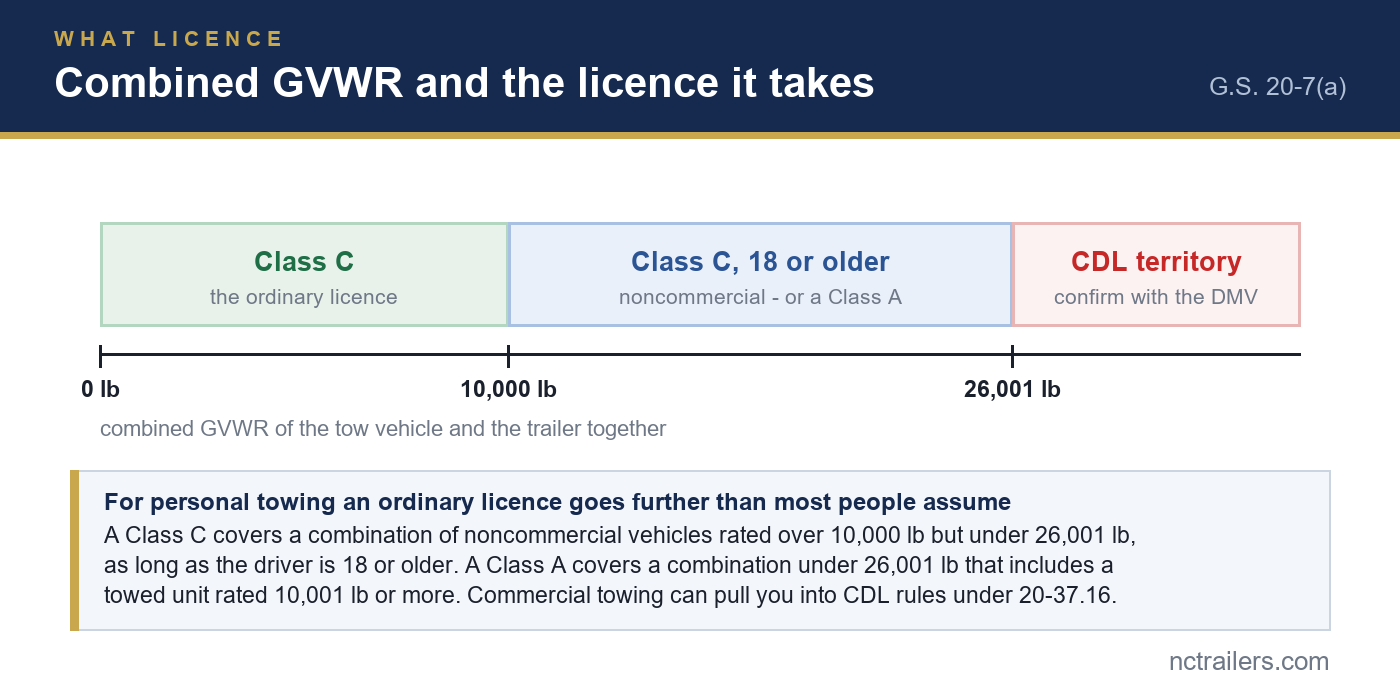
A regular Class A licence covers a combination under 26,001 pounds combined GVWR that includes a towed unit rated at 10,001 pounds GVWR or more.
But a regular Class C licence, the ordinary licence most people carry, also covers a combination of noncommercial vehicles rated over 10,000 pounds but less than 26,001 pounds, as long as the driver is 18 or older.
What that means on the lot
For personal, noncommercial towing, an ordinary Class C licence goes further than most people assume. A 14,000 lb dump trailer behind a 3/4-ton truck is still Class C territory for a private owner. Commercial use is a different question and can pull you into CDL rules under G.S. 20-37.16. If you tow for work, or your combination approaches 26,001 pounds, confirm your class with the DMV rather than guessing.
Source: G.S. 20-7(a)
The Class C reach described above is the rule for a North Carolina licence holder. Licence classes are written state by state, and some draw their noncommercial classes far tighter.
The 26,001-pound figure itself comes from the federal CDL threshold, so it is a familiar number nationally — but that federal line governs commercial driving. What an ordinary licence covers for personal towing is each state’s call, not a national standard.
Quick reference
| Rule | Limit | Statute |
|---|---|---|
| Maximum width, vehicle or load | 102 in (8 ft 6 in) | 20-116(a) |
| Boat or boat trailer, no permit needed under | 120 in, amber lamps over 102 in | 20-116(m) |
| Maximum height | 14 ft, but plan around 12 ft 6 in | 20-116(c) |
| Maximum length, single vehicle | 40 ft | 20-116(d) |
| Maximum length, combination | 60 ft, two units | 20-116(e) |
| Trailer brakes required at | 4,000 lb gross weight | 20-124(f) |
| Annual safety inspection required at | 4,000 lb gross weight | 20-183.2(a) |
| Ordinary Class C licence covers up to | 26,001 lb combined GVWR, noncommercial | 20-7(a) |
Questions about a specific trailer?
We title and tag trailers every day, and we handle state and federal inspections. Bring us the trailer, or call and describe it, and we will tell you which of these rules land on you.
Thomasville 336-475-5054
Winston-Salem 336-499-9888
Shopping rather than checking a rule? Apply for financing, look at rent to own, or browse what is on the lot.
Related reading
- Trailer Tire Pressure and Lug Nut Torque
- Federal Annual DOT Inspection
- Local Regulations for Trailer Owners in North Carolina
- Trailer Towing: When Do You Need a CDL?
This page is a plain-language summary of North Carolina law, not legal advice. Statutes change. The linked statute text on ncleg.gov is the authority.