

Scissor hoist vs. telescopic hoist: how a dump trailer lifts its bed
Every dump trailer raises its bed with hydraulics, but not every one does it the same way. Most use either a scissor hoist folded up under the bed or a telescopic cylinder standing at the front of it. This page shows how to tell them apart and what each design's builder says it does better.
We sell dump trailers built both ways, so instead of picking a winner we let two manufacturers make their own case: Southland Trailer Corp., which builds scissor hoists, and Diamond C Trailers, which builds telescopic dumps. Their documents are listed at the bottom of the page.
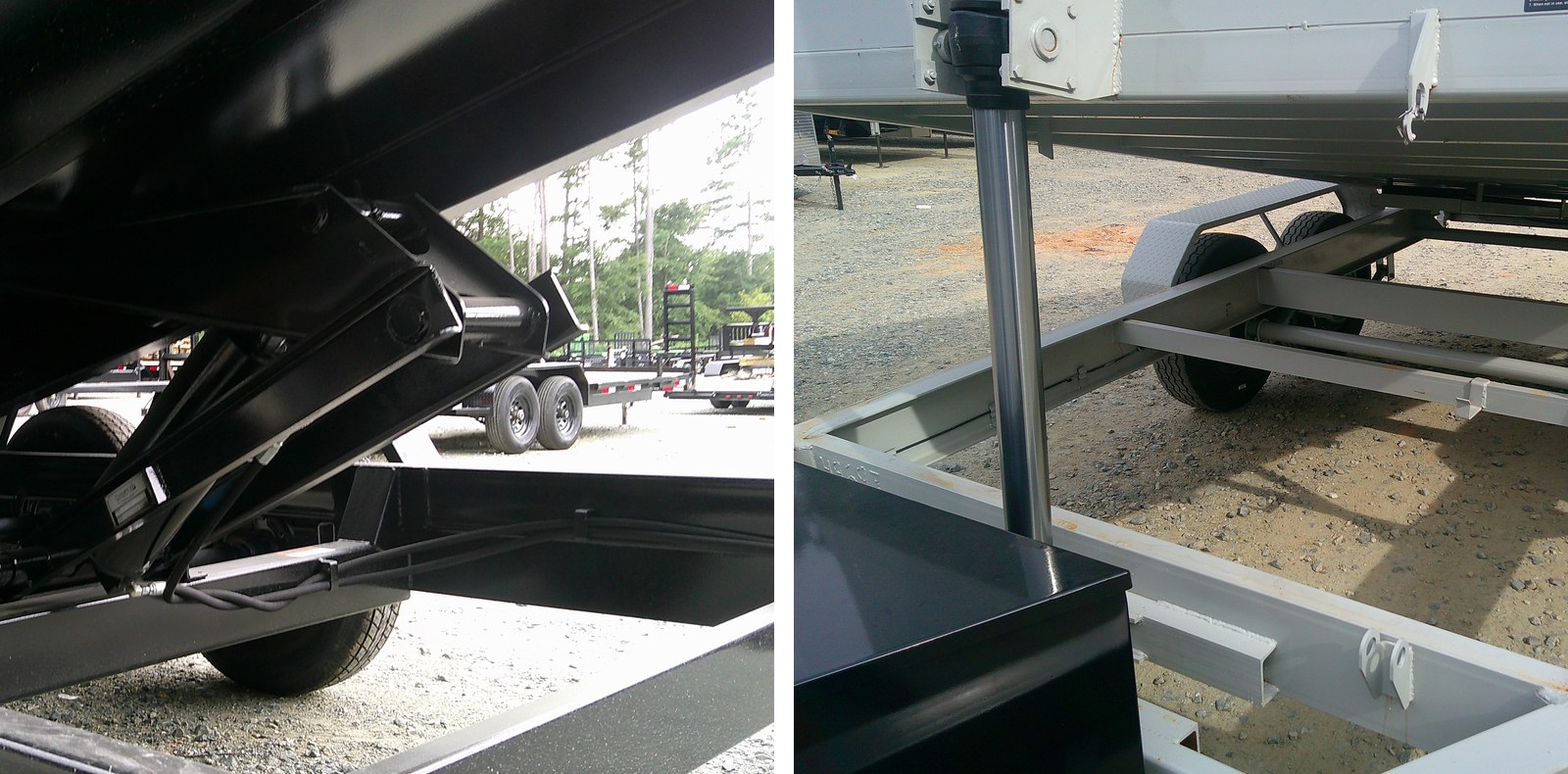
How to tell which one you are looking at
Raise the bed partway and look at the front of the trailer.
- Telescopic: a single round cylinder stands up between the front of the bed and the trailer frame, usually just behind the toolbox or pump box. As it extends, you can see it come out in stages, one tube sliding out of the next.
- Scissor: nothing stands at the front. The cylinder lies under the bed and pushes a folding steel linkage that opens like a pair of scissors as the bed rises. With the bed down, it is tucked out of sight.
Southland's case for the scissor hoist
In a September 2026 dealer training video walking through its dump line, Southland made these points about its scissor hoists:
- Power up and power down. Southland's hoist uses hydraulic power in both directions. Southland contrasts that with the telescopic dumps it sees, which it describes as power up, gravity down, and says that in cold weather, when the hydraulic fluid is cold, a gravity-down bed is slow to come back down.
- Fewer seals. Southland points out that a telescopic cylinder has several stages and each one has its own seal, while its scissor hoist runs on one cylinder with one seal.
- Out of the way. With the hoist folded under the bed, there is nothing standing at the front to bump into. Southland tells the story of an arborist loading logs with a boom who did not want a cylinder in the way.
- Load spread through the floor. Southland ties its hoist into an engineered sill under the box, which it says spreads the lifting load across the whole floor.
Our product page for the Southland SL714-14K lists its hoist as power up and power down.
Diamond C's case for the telescopic cylinder
Diamond C's article comparing the two designs makes these points for the telescopic side:
- Lifting power from the front. Diamond C says mounting the cylinder at the front of the bed gives it a mechanical advantage, because it pushes from the far end of the bed away from the pivot.
- Less stress on the frame. Diamond C says a telescopic cylinder spreads the lifting force more evenly, where a scissor hoist puts concentrated pressure on specific points of the frame.
- Uneven loads and a steep angle. Diamond C says its telescopic cylinders handle imbalanced loads well and reach a full 45-degree lifting angle.
- Easier service. Diamond C says its cylinder comes out by pulling two quick-release pins, and that servicing a scissor hoist means working around lifted parts.
How to choose
Notice that each builder argues for the design it makes, and some of their points pull in opposite directions. Both designs dump a load. The better question is what the specific trailer is rated for and how you will use it.
- Start with payload. Pick a trailer rated to carry the heaviest load you plan to haul, not the typical one. Payload is the GVWR minus the empty weight of the trailer, and both numbers are on the compliance label. Our GVWR and payload guide explains the difference.
- Think about what loads the trailer. If a loader, boom or grapple swings over the front of the bed, a cylinder standing there is one more thing to keep clear of.
- Ask how the bed comes down. Find out whether the hoist is powered down or lowers by gravity, especially if you dump through the winter.
- Ask who services it. Either way, the hydraulics need care. Our service department works on dump trailer hydraulics at both locations.
Whichever hoist you choose, the safety rules are the same: dump on firm, level ground, watch for power lines overhead, and only work under a bed that is empty and resting on its body prop. Our dump trailer safety guide covers each step.
Want to see both side by side?
Come raise a bed yourself. We keep scissor and telescopic dump trailers on the lot, and we can walk you through the ratings on each one.
Thomasville: (336) 276-0329
Winston-Salem: (336) 499-9888
Rather type than talk? Send us a message. Or browse dump trailers in stock.
Related guides
- How to dump a trailer safely, from loading to propping the bed.
- Dump trailer buying guide, sizes, gates and options.
- What size dump trailer do you actually need?
- Understanding GVWR and payload.
- Roll-off trailers: sizing and bin capacity, when one trailer needs to carry several bins.
- Trailer service at NC Trailers, including hydraulics.
Sources
- Southland Trailers, Live Dealer Training: A closer look at some of our dump trailer lineup (September 2026), for the scissor hoist points.
- Diamond C Trailers, Telescopic Cylinder vs. Scissor Hoist (April 2024), for the telescopic points.
- Nolan Manufacturing, Dump Trailer Owner's Manual, for the dumping safety rules.