

How to Dump a Trailer Safely: Level Ground, the Body Prop and Stuck Loads
A dump trailer is stable on the road and a lot less stable with the bed in the air. Raising a loaded bed moves a lot of weight up and back in a few seconds, and most dump trailer injuries happen right then: on soft ground, under a power line, or underneath a bed that was never meant to be held up.
The steps on this page come from the owner's manual Nolan Manufacturing publishes for its bumper pull dump trailers (July 2025 edition). Nolan builds in Denton, NC, and is one of the dump trailer lines we sell. Hoists and controls differ from one trailer to the next, so keep your own trailer's manual handy too. The manuals are linked at the bottom of the page.

Before you load: hook it up and park it level
- Couple the trailer to the truck first. Nolan's manual says a dump trailer must be coupled to the tow vehicle before it is loaded, and not to load or unload it otherwise. An uncoupled trailer can tip or lift as the weight goes on.
- Park on firm, level ground, both front to back and side to side. Loading on soft or uneven ground can roll the trailer over.
- Close and latch the rear doors before the first scoop goes in.
Load it by weight, not by how full it looks
The number that matters is your trailer's payload, not its GVWR. GVWR is the most the whole trailer can weigh with the load on it, and the trailer itself counts against it. The payload is printed on the tire and loading label as "the weight of cargo should never exceed" a set number of pounds.
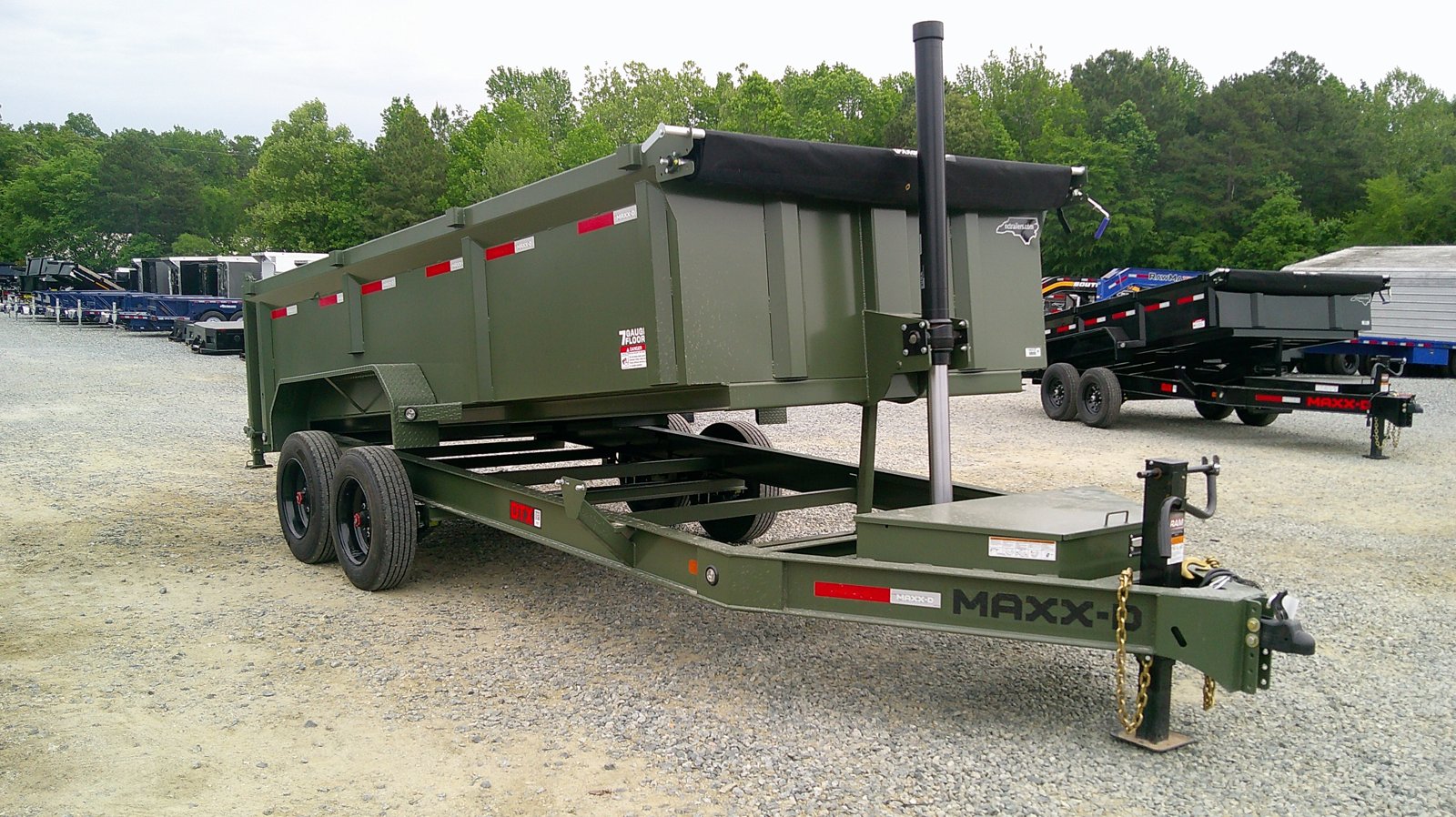
Nolan's loading steps for bulk material:
- Tell the loader operator your trailer's payload. They will have an approximate weight for the material.
- If you are not sure what the material weighs, load a small amount and weigh the trailer. It is much easier to add to a light load than to dig out an overloaded one.
- Spread the load evenly, front to back and side to side.
- Tarp it if any of it could blow out on the road.
- If the trailer is overloaded, do not raise the bed. Take the extra material out by hand or with equipment first.
Gravel and other dense material hit the payload long before the bed looks full. Our GVWR and payload guide walks through the math.
Raising the bed
- Look up first. Check for overhead power lines and tree limbs before the bed goes up. Nolan's manual warns that electrocution can happen without the bed touching the line.
- Stand clear and stay at the controls. Keep other people away, never leave the controls while the bed is moving, and never walk away from the trailer with the bed up.
- Raise it in stages. Stop at about the halfway point, or sooner if the load starts sliding back. Walk to the rear and check there is room for the rest of the load. If there is not, lower the bed, pull forward and go again. Then raise it to about three quarters and check again.
- Do not fully raise a loaded bed. With the whole load hanging off the back, the truck's rear wheels can lose traction.
- Spreading as you drive? The ground you drive over has to be firm and level too, and you drive slowly.
When the load sticks
This is where people get hurt trying to save a few minutes. Nolan's manual is specific:
- Do not drive forward and stop hard to shock the load loose, and do not jerk the control button up and down.
- Lower the bed all the way and free the material by hand. Never try to free a load from a raised bed.
- If the hoist will not lift the load, take material out. Never help the hoist with a jack, a crane or another machine, and have a hydraulics technician look at it.
The body prop is for an empty bed only
Every dump trailer has a body prop, a bar that holds the bed up so you can work underneath it. Nolan's manual puts the rule in a DANGER box: the body prop is designed to support an empty dump body only. Never hold up a loaded bed with it, and never go under the bed unless it is empty and sitting on the prop.
Using it the way the manual lays out:
- Park on firm, level ground and empty the bed.
- Raise the bed, swing the prop up into its upright position, and lower the bed onto it. The prop has to seat in its receiver.
- If your trailer has power-down hydraulics, let go of the down button as soon as the bed rests on the prop. Holding it can damage the trailer.
- Nobody moves the prop while someone else is at the controls.
Leave the hydraulics as they came
Nolan's manual says to never alter or substitute any part of the hydraulic system, because a modified system can let the bed fall without warning. If the hoist is slow, leaking or will not hold, bring it to a shop with the right parts.
Need a hand with yours?
Hoist acting up, or shopping for a dump trailer rated for what you actually haul? Our service team works on trailer hydraulics, and our sales team can match a trailer's payload to your heaviest load.
Thomasville: (336) 276-0329
Winston-Salem: (336) 499-9888
Rather type than talk? Send us a message.
Related guides
- What size dump trailer do you actually need?
- Understanding trailer GVWR and payload, for reading the labels.
- Used dump trailers: what to inspect before you buy.
- Pre-trip towing inspection checklist.
- Trailer breakaway systems, how they work and how to test one.
- Trailer service at NC Trailers.
- Dump trailers in stock.
Sources
- Nolan Manufacturing, Dump Trailer Owner's Manual, Bumper Pull Trailers (July 2025), sections 2.2.15 and 5.1 to 5.5, for every loading, dumping and body prop step above.
- Nolan Manufacturing, product manuals page, for the trailer, dump trailer and axle manuals.
- The GVWR and cargo figures in the photo caption are read off that trailer's own compliance label and tire and loading label.