
Enclosed trailer sizing trips up more buyers than almost any other part of the purchase decision. The temptation is to go by feel, picking something that seems about right without anchoring that instinct to the actual dimensions of the cargo, the interior height requirements, or the tow vehicle’s capacity. The result is often a trailer that is either too small for the job within the first season or larger than necessary, with a price tag and payload weight to match.
This guide gives first-time buyers and small business owners a practical framework for getting the size right before purchasing. It covers how to think about width, length, and height in terms of your actual cargo, what axle configuration fits which weight class, how to measure correctly, and what NC Trailers carries across the enclosed trailer category.
Why Enclosed Trailer Size Matters More Than It Seems
An enclosed trailer that is too small creates daily problems. Cargo that does not fit means either leaving equipment behind or rearranging the load every trip. A trailer that is too tall or too wide creates clearance issues in parking structures, low-clearance loading areas, or narrow urban streets. A trailer that exceeds the tow vehicle’s rated capacity is a legal and safety problem regardless of how the rest of the setup looks.
Sizing up unnecessarily adds cost at every level: higher purchase price, higher financing payment, more weight on the tow vehicle, and reduced fuel economy on every trip. Getting the size right means matching the trailer to what the job actually requires, not what the maximum option looks like.
Common Enclosed Trailer Sizes and Their Typical Uses
Enclosed trailers are typically described by their interior width and length. A 6x12 trailer is six feet wide by twelve feet long on the interior floor. Width runs from five to eight-plus feet depending on configuration. Length typically runs from eight to thirty-plus feet on larger units. For most small business and personal buyers, the relevant range is six to eight-and-a-half feet wide and ten to twenty-four feet long.
5x8 to 6x10: Personal and Small-Volume Use
The smallest enclosed trailer configurations suit personal use and very light commercial applications. A 5x8 or 6x10 fits motorcycles, ATVs, small equipment, or a modest amount of cargo. These trailers are light enough to be towed by a car or smaller SUV and are the most affordable entry point in the enclosed trailer category. The limitation is clear: they fill up quickly and are not practical for business use beyond the most compact applications.
6x12 to 7x14: The Most Versatile Range
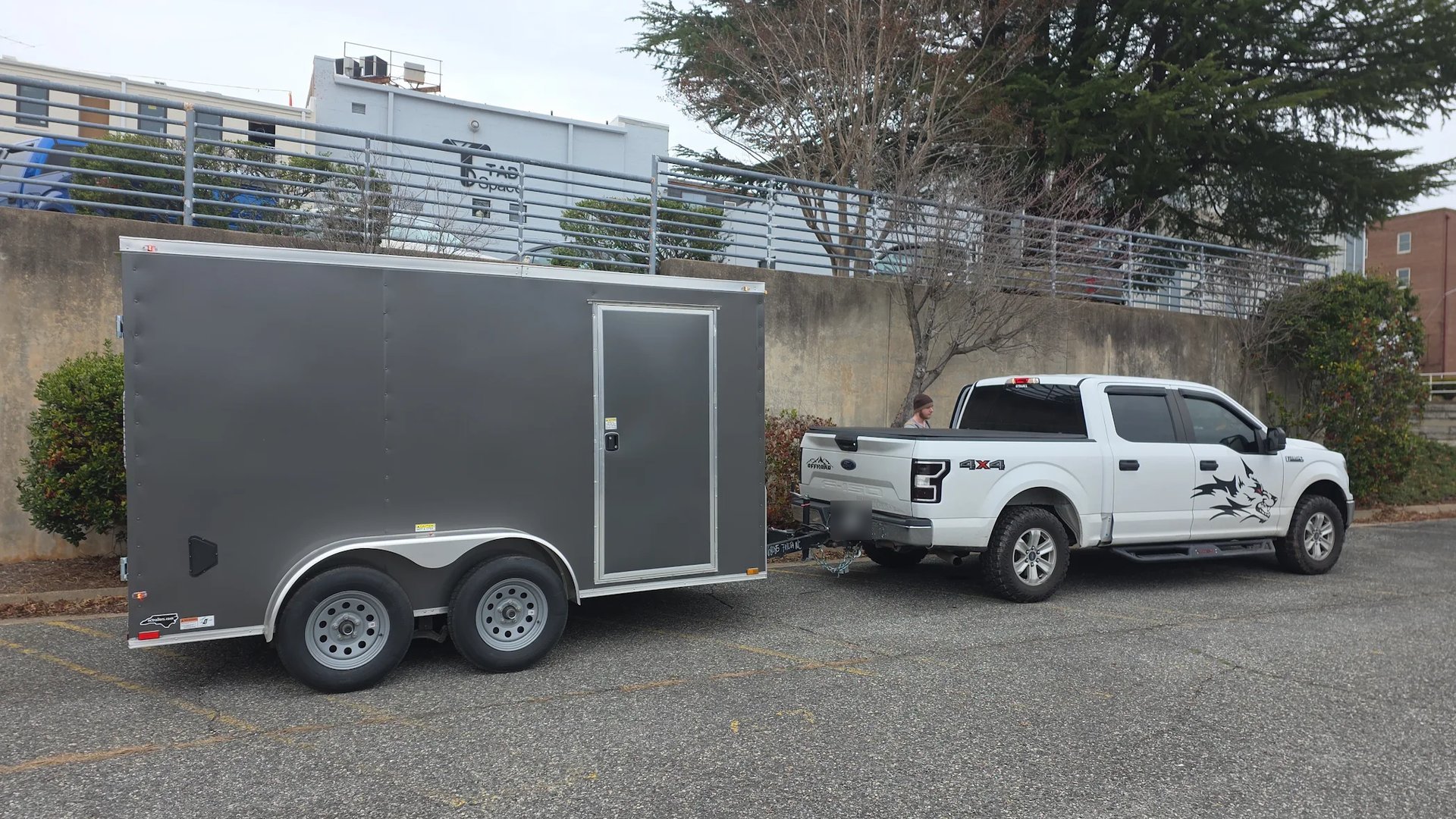
The 6x12 to 7x14 range is the most commonly purchased segment for both personal and small business buyers. A 6x12 handles two motorcycles, a side-by-side ATV, a small car hauler application, contractor tools and materials, or a moderate amount of product inventory. A 7x14 adds meaningful floor space that allows for better organization, shelving systems, and larger cargo without becoming difficult to maneuver. Detailers, mobile service businesses, small contractors, and hobbyists with moderate cargo volumes consistently land in this range.
7x16 to 8.5x20: Commercial and High-Volume Applications
Trailers in the 7x16 to 8.5x20 range serve small businesses with higher cargo volume requirements, operations that use the trailer as a rolling storage unit, and buyers who need to transport large equipment inside a weatherproof shell. An 8.5-foot wide trailer provides a full eight feet of usable interior width, which is the threshold at which full-size pallets, large equipment, and side-by-side organization systems become practical. Electricians, plumbers, mobile retailers, and small distributors commonly operate in this size range.
Interior Height and Floor Length: What to Consider for Different Cargo Types
Width and length get most of the attention during the size decision, but interior height can be equally important depending on what is being transported or stored.
Standard enclosed trailers have interior heights typically ranging from five and a half to six feet. That is adequate for most cargo storage and equipment transport applications but does not allow the average adult to stand fully upright inside the trailer. If the trailer will be used as a mobile workspace where standing is required, such as a mobile detailing unit, a service trailer, or a trade show display trailer, interior height becomes a functional requirement rather than a nice-to-have.
Floor length determines not just how much fits but how it can be positioned. A cargo item that is ten feet long needs more than ten feet of usable floor length after accounting for the door ramp and any front interior obstruction. Measure your largest cargo item before selecting a trailer length and add at least two feet of margin for loading clearance.
Single vs. Tandem Axle for Different Weight Classes
Axle configuration determines the payload capacity of the trailer and affects towing stability. For enclosed trailers, the choice between single and tandem axle is largely driven by the weight of the cargo.
Single-axle enclosed trailers are lighter and less expensive. They are appropriate for applications where the total loaded weight, trailer plus cargo, stays well within the trailer’s GVWR and where towing stability at highway speeds is not a major concern. For smaller trailers carrying light cargo, a single axle is usually sufficient.
Tandem-axle enclosed trailers handle heavier loads more reliably, tow more stably at highway speeds, and provide a built-in safety margin if a tire fails on the road. For commercial applications where the trailer is loaded consistently near its capacity, or for any application where the trailer covers significant highway mileage, tandem axle is the better configuration. The additional cost is justified by the operational reliability and safety margin it provides.
How to Measure Your Largest Cargo Item Before Buying
The most reliable way to avoid a sizing mistake is to measure before you shop. This means physically measuring the largest item you plan to transport regularly, not estimating from memory.
Measure length, width, and height of the cargo item. Then compare those dimensions against the interior dimensions of the trailers you are evaluating, not the exterior dimensions, which are typically several inches larger on each side. Also account for how the item will be oriented in the trailer: a cargo item that can be positioned lengthwise may fit in a shorter trailer than one that must be loaded sideways.
If you are buying for cargo volume rather than a single large item, estimate the cubic footage of a typical full load and compare that to the interior cubic footage of the trailer options. Interior cubic footage is width multiplied by length multiplied by usable interior height. Leave yourself a 20 to 30 percent volume buffer to account for irregular cargo shapes and the space needed to organize and access cargo during the workday.
NC Trailers Enclosed Trailer Inventory and Brand Options
NC Trailers carries enclosed trailers across a range of sizes at both the Thomasville and Winston-Salem locations. Available brands include options suited for both personal and commercial use across the size tiers described in this guide.
The enclosed trailer inventory page shows what is currently in stock at both locations with interior dimensions, axle configuration, and pricing. For buyers who want to see the interior of a specific configuration before committing, stopping in at either location is the most reliable way to confirm the fit for your application.
Financing is available on enclosed trailers through NC Trailers’ lender network. For buyers evaluating how to structure the purchase, the trailer financing page covers the available options. Buyers from the Charlotte, Greensboro, Raleigh, and surrounding markets regularly visit both NC Trailers locations to compare enclosed trailer options before making a decision.
Getting the size right is the decision that determines whether the trailer serves the operation or constrains it. Measure before you shop, account for interior height and axle requirements alongside floor dimensions, and talk to the team at either NC Trailers location if you want a second opinion before committing.
Want help picking the right enclosed trailer size?
Call us, stop by either lot, or fill out the financing request just below and we will get right back to you.
 About the Author