
Reliable cold storage has historically been one of the more expensive infrastructure requirements for a small food business. Walk-in coolers are fixed to a location. Commercial refrigerators limit how much product can move and where it can go. For food businesses that operate at multiple locations, serve outdoor events, or move product between a production kitchen and a point of sale, a refrigerated cargo trailer provides mobile cold storage at a scale and price point that fits small-business operations.
This guide covers why small food businesses choose refrigerated cargo trailers over larger commercial refrigeration options, the most common use cases in North Carolina, the size and cooling unit options worth evaluating, food safety considerations for trailer-based cold storage, and how to finance a refrigerated trailer purchase through NC Trailers.
Why Small Food Businesses Choose Refrigerated Cargo Trailers
The appeal of a refrigerated cargo trailer for a small food business is straightforward: it is mobile, self-contained, and sized for operations that do not need a full commercial refrigerated truck or a fixed walk-in installation.
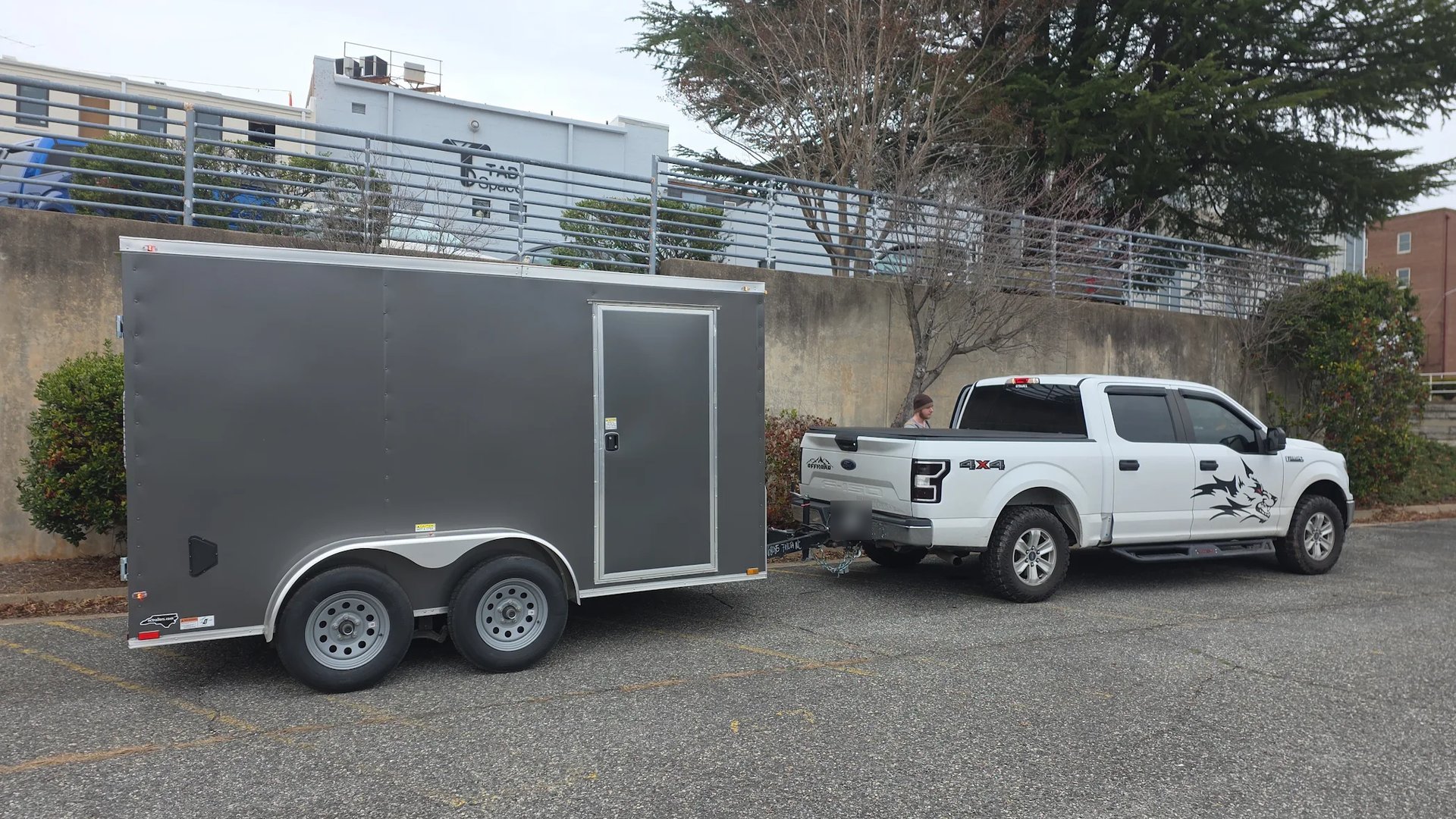
A refrigerated cargo trailer can be hitched to a pickup truck and driven to a farmers market, a catering venue, a festival site, or a distribution point. It does not require a commercial driver's license to tow in most configurations. It can be parked at a venue for a multi-hour event and maintain temperature independently. And when the event or the route is done, it comes back to the home location and disconnects, functioning as a stationary cold storage unit until the next use.
For small food businesses operating with tight margins and limited capital, this flexibility is meaningful. A refrigerated cargo trailer is a single asset that serves multiple functions, replacing the need for separate cold storage solutions at each point in the supply and distribution chain.
Common Use Cases: Farmers Markets, Catering, and Cottage Food Producers
Refrigerated cargo trailers show up across a range of small food business models in North Carolina. The common thread is a need for reliable cold storage that travels with the business rather than anchoring it to a fixed location.
Farmers Market Vendors
A farmers market vendor selling meat, dairy, cut produce, prepared foods, or other perishables needs to maintain safe temperatures from the time product leaves the production facility through the end of the market day. Coolers and ice work for very small volumes over short windows, but they require constant management and fail under warm ambient conditions or extended sales periods. A refrigerated cargo trailer parked at the market maintains the set temperature across a full eight-hour market day without intervention, which frees the operator to focus on customers rather than ice replenishment.
Caterers
A catering operation serving outdoor events needs on-site cold storage that scales with the event size. Refrigerated cargo trailers allow caterers to pre-stage cold food at the venue hours before service, hold product at safe temperatures through a multi-hour event, and transport prepared food from the production kitchen without relying on coolers and ice to maintain temperature compliance. For caterers working outdoor weddings and corporate events in North Carolina's warmer months, active refrigeration is the difference between reliable temperature control and hope.
Cottage Food Producers and Small Distributors
Small food producers who sell through multiple retail accounts, specialty food distributors serving local restaurants and grocers, and cottage food operations that sell refrigerated products at multiple locations all face the same core logistics problem: getting product to multiple destinations while maintaining cold chain integrity. A refrigerated cargo trailer solves this by providing a mobile cold chain that the producer controls directly, without depending on third-party cold storage or the uncertain temperature management of personal vehicles.
Size and Cooling Unit Options to Evaluate
Refrigerated cargo trailers suited for small food businesses run from compact units in the 6x10 range up to mid-size configurations in the 7x16 range. The right size is determined by the volume of product you need to hold at peak capacity and the tow vehicle you are working with.
Smaller trailers are lighter, less expensive, and easier to maneuver at market locations and event venues with limited space. They suit vendors and producers with focused, moderate-volume operations. Mid-size trailers provide meaningfully more interior volume and allow for shelving systems that increase usable storage capacity beyond what the floor space alone suggests.
The refrigeration unit needs to be properly matched to the trailer's interior volume and the ambient temperatures it will operate in. A unit that is undersized for the trailer will struggle to maintain temperature on a hot North Carolina summer afternoon when the door is being opened for customer access or loading. Verify the unit's BTU capacity relative to the trailer size and your intended operating conditions before purchasing.
Shore power capability, which allows the refrigeration unit to run off a standard electrical outlet rather than its own power source, is useful for vendors who have access to power at their market location or event venue. It reduces operating cost during stationary use and eliminates engine noise. Confirm that the venue provides adequate power access before depending on shore power as the primary option.
Food Safety Considerations When Using a Refrigerated Trailer
A refrigerated cargo trailer is a tool for maintaining food safety, and using it correctly requires the same discipline that any commercial cold storage operation demands.
Pre-cool the trailer before loading. Running the refrigeration unit for 30 to 60 minutes before product goes in brings the interior to the target temperature. Loading product into a warm trailer and expecting the unit to rapidly pull the temperature down stresses the refrigeration system and risks temperature compliance during the cooling window.
Load product that is already at or below the target temperature whenever possible. A refrigeration unit maintains temperature. It is not designed to rapidly chill warm or room-temperature product to a safe holding temperature, and relying on it to do so creates compliance risk and equipment stress.
Keep a temperature log if your operation is subject to food safety inspection. Being able to demonstrate that the trailer maintained the required temperature throughout the transport or holding window is part of regulatory compliance for many food handler permit types. A simple digital thermometer with a data logging function is an inexpensive investment for operations that need documentation.
NC Trailers Refrigerated Cargo Trailer Inventory and Financing
NC Trailers carries refrigerated cargo trailers suited for small food business use at both the Thomasville and Winston-Salem locations. These are purpose-built small-business units with integrated refrigeration, not commercial reefer trailers designed for over-the-road freight. Current available configurations are listed on the refrigerated trailers inventory page.
Seeing the interior configuration and refrigeration unit specification in person is the most reliable way to assess whether a specific unit fits your volume requirements and operating conditions. The team at either location can walk through the cooling unit capacity relative to the trailer size and help identify which configuration fits the intended application.
Financing is available for qualified buyers through NC Trailers' lender network. A refrigerated cargo trailer purchased for business use may also qualify for Section 179 tax treatment in the year of purchase, which is worth discussing with your accountant before buying. More information on financing is on the trailer financing page. Food businesses from the Charlotte, Greensboro, and Raleigh markets visit both NC Trailers locations regularly to evaluate refrigerated cargo trailer options.
A refrigerated cargo trailer is not the right tool for every food business, but for those whose operations require reliable mobile cold storage, it is an investment that pays back in operational flexibility, food safety reliability, and the ability to take on events and accounts that passive cooling cannot support.
 About the Author