
Most boat owners ignore the trailer until launch day reminds them why they shouldn't. Bearings still packed with last year's grease, a brake actuator full of water, tires that crack the first time they see highway speed: a pre-season once-over catches all of it for about $50 in parts instead of stranding you on the shoulder of I-40 with a boat behind you. This checklist runs through the inspection roughly in the order things actually fail. It also gives you the bearing schedule we hold every trailer to and points out which jobs you can do yourself and which are worth handing to a shop.
Why a boat trailer needs more attention than other trailers
Boat trailers take two kinds of abuse no other trailer does: they get dunked at the ramp over and over, and they sit loaded for months between trips. The dunking pushes water past bearing seals, into wiring connectors, and into any brake actuator that isn't sealed up tight. The sitting is its own problem. A 4,000-pound boat parked on the same bunk spots for six months flattens rollers, compresses the bunks, and lets corrosion get a start at every bolted connection. The good news is that both kinds of damage are predictable and easy to spot once you know where to look.
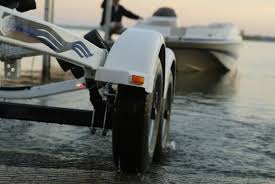
Wheel bearings, and the schedule we hold every trailer to
Bearings fail more than anything else on a boat trailer, so this is the part to get right. Repack them every 6 months or 12,000 miles, whichever comes first. That is the interval we give every customer, boat trailer or not.
You will see 12 months or 12,000 miles published by axle manufacturers. We cut the time side of that in half, because the months are what get you, not the miles. A boat trailer that covers 800 miles a year still spends those months with hot hubs going into cold water, and that is the cycle that pulls moisture past a seal. Time the repack so one of them lands before the first launch of the season.
Pull a hub and look at the grease. Good marine grease is tan to amber and even in texture. If it's gray, milky, or has water beads in it, water has gotten past the seals, and the bearings need to come out for cleaning, a close look, and maybe replacement.
Salt does not change the repack interval, but it does change how closely you watch the seals. Salt hardens seals and rusts bearing races faster than freshwater does, so if you trailer down to Wrightsville, Beaufort, or Topsail, rinse the hubs every trip and look at the seals between repacks rather than waiting for the next one. Same schedule, more inspections.
Use real marine grease, not the multipurpose automotive stuff. Automotive grease isn't made to stay put when it gets wet and will wash out and turn milky after a few launches. Marine grease, with a lithium-complex or calcium-sulfonate base, is built to keep lubricating after the hub goes underwater.
One warning about Bearing Buddies. Those spring-loaded grease caps aren't a substitute for repacking. Pumping grease in through the cap pressurizes the hub but doesn't flush the old, dirty grease out. Push in too much and you can blow the rear seal and force grease into the brake drum, which ruins the brakes and leaves you with none on the next launch. Add grease until the piston just starts to move, then stop.
Quick test: jack each wheel up and spin it by hand. You want it smooth and quiet. Any grinding or grittiness means the bearings have to come out. After your first highway tow of the year, pull over around the 10 to 15 mile mark and put the back of your hand on each hub. Warm is fine. One hub noticeably hotter than its partner, or too hot to touch, means it's low on grease or starting to fail.
Bunks, rollers, and where the boat sits
Press on the bunk boards and feel for soft spots, which mean water has gotten under the carpet and into the wood. Carpet that's worn down to bare wood, or that's gone hard and rough, will scuff the gelcoat the next time you launch, and the boat doesn't have to be moving fast for that to happen.
If you've got a roller trailer, check each roller for cracks, flat spots from sitting under load, and general hardening. A roller that's gone hard sounds different when you tap it, and a good one still has some give to it. Spin each one by hand to make sure it turns freely. If any bracket has shifted or come loose, snug it back down before you launch.
Worn carpet or flat-spotted rollers are cheaper and easier to fix now than in the middle of the season. Recovering bunk carpet runs $30 to $60 a board, and rollers are $15 to $40 each depending on size.
Wiring and lights, where the dunking does its damage
Trailer lights are required by law, so test every one with the trailer hooked to the tow vehicle: brakes, running lights, both turn signals, and the reverse lights if you have them. Have someone work the controls while you walk around the back.
Look over the wiring harness for chafed spots, bare copper, and corroded connectors. Every time the trailer goes underwater, moisture works into the electrical connections, and a corroded connector is the most common reason lights start cutting in and out. Clean off any green or white crud with electrical contact cleaner and pack each connection with dielectric grease to keep water out going forward.
Sealed LED lights beat the old incandescent bulbs for boat trailers because they last longer, throw more light, and draw less current. They still aren't bulletproof. If you see fog or condensation inside the lens, a cracked housing, or a hazed-over lens, replace the unit. Once water gets inside, the LED driver usually dies within a few months.
Tires, where age matters more than tread
Trailer tires usually die of old age before they wear out. Most boat trailers never see enough miles to wear the tread down, but the rubber oxidizes and cracks over the years whether you use it or not.
Check the sidewalls for cracking, dry rot, and weathering. The DOT date code on the sidewall tells you how old the tire is: the last four digits are the week and year it was made, so "3622" means the 36th week of 2022. NHTSA and the major tire makers say to replace trailer tires at six years no matter how much tread is left. A six-year-old tire can look perfectly good and still have lost enough strength to blow out at highway speed under load.
Set pressure with a gauge against the number on the sidewall, not by how the tire looks. Boat trailer tires, the ones with the "ST" special-trailer rating, usually run 50 to 65 PSI, and a tire loses pressure just sitting over the winter even when it has no leak.
Brakes: surge versus electric, drum versus disc
Most boat trailers use surge brakes, which work off a hydraulic actuator built into the coupler. When the tow vehicle slows, the trailer's weight pushes the coupler forward, that pressure builds in the actuator, and it applies the brakes at the wheels, either drum or disc.
To check it before the season, unhook the trailer, chock it, and push the coupler forward by hand. It should build resistance smoothly without a lot of slop, then spring back out when you let go. Check the fluid in the actuator reservoir and top it up if it's low. Use DOT 3 brake fluid, nothing else, not power steering fluid or transmission fluid. If the fluid is dark, dirty, or low, water has gotten in or there's a leak, and the system should be bled and refilled before you launch.
With drum brakes, it's worth pulling a drum once a year to look at the shoes. Check whether the shoes are worn down near the rivets, whether the drum surface is scored, and whether the wheel cylinder is leaking.
Disc brakes are showing up more on saltwater trailers because they shed water faster than drums and hold up better against corrosion. On those, look at the rotor for deep scoring or rust pitting and check the pad thickness through the opening in the caliper. The caliper pins should slide freely. Seized pins are a common problem on trailers that live outside.
Electric brakes aren't as common on boat trailers, but you'll see them on some bigger rigs. Make sure the controller in the tow vehicle is actually firing the trailer brakes, then do a few easy stops from low speed to feel that they come on smoothly without grabbing or pulling.
Winch, coupler, and hitch hardware
Look the winch strap over for fraying, abrasion, and sun damage. If it's cracked near the hook or the fibers are separating inside, replace it. Straps tend to let go at the worst possible moment, usually halfway up the ramp on a windy day. Run the winch both directions and make sure the ratchet locks.
Check that your coupler and hitch ball are the same size. The size is stamped on the underside of the coupler latch: 1-7/8 inch, 2 inch, or 2-5/16 inch. Drop a 2 inch coupler onto a 2-5/16 inch ball and it will look hooked up, but the latch never actually grabs, and the trailer can come off at the first hard stop. It's one of the most common ways trailers come loose, and it takes about 30 seconds to confirm the sizes match. Tongue weight should sit around 7 to 15 percent of the loaded trailer weight. If the tongue jumps up when you push down on it, the boat is sitting too far back on the bunks.
Check the safety chains for stretched links, rust pitting, and bent hooks. Hook them so they cross under the tongue. That way, if the coupler ever lets go, the tongue lands in the crossed chains instead of on the road. Replace any chain that's been in a wreck or has rusted down thin.
What to do yourself and what to leave to a shop
You can handle plenty of this yourself: testing the lights, cleaning connectors, checking tire pressure and date codes, eyeballing the winch strap, confirming the coupler matches the ball, looking over the bunks and rollers, and feeling the hubs after that first short tow.
Other jobs are better left to a shop unless you've done them before and have the tools. That list includes a full bearing repack, servicing the brake actuator fluid, pulling drums or calipers to inspect shoes and pads, checking axle alignment, any wiring repair past a simple connector cleanup, and fixing bunk frames or roller mounts.
A good rule: if the job involves the hydraulics, the sealed bearings, or anything that could come apart at highway speed with a boat behind you, it's worth paying someone who does it every day. Bearing repacks and brake work are the two things owners skip most, and they're the two things most likely to put you on the shoulder.
NC Trailers does pre-season boat trailer service at both the Thomasville and Winston-Salem shops. The schedule fills up fast in March and April once everyone's getting ready for the season, so it pays to book early. Call Thomasville at 336.276.0329 or Winston-Salem at 336.499.9888, or set it up on the service page.
Quick pre-launch checklist
- ✔ Repack the wheel bearings every 6 months or 12,000 miles, whichever comes first, and check the grease for a milky or gray color
- ✔ Spin each wheel by hand and listen for grinding
- ✔ Feel the hubs after the first short tow; one running hotter than the others means trouble
- ✔ Press on the bunk boards for soft spots and check the carpet for bare wood
- ✔ Spin the rollers and look for flat spots and cracks
- ✔ Test every light: brakes, running lights, both turn signals, and reverse
- ✔ Clean corroded connectors and pack them with dielectric grease
- ✔ Check the tire date codes and replace any tire six years or older
- ✔ Set tire pressure to the number on the sidewall
- ✔ Top up the surge actuator with DOT 3 fluid and check that the coupler moves smoothly
- ✔ Inspect the brakes: drum shoes, or disc pads and rotor
- ✔ Check the winch strap for fraying and test the ratchet
- ✔ Confirm the coupler and the hitch ball are the same size
- ✔ Check the tongue weight, around 7 to 15 percent of the loaded weight
- ✔ Inspect the safety chains and hook them crossed under the tongue
 About the Author