

Most people shopping for a car hauler ask two questions: will my vehicle fit on it, and can my truck pull it. Those are the right questions. The trouble is the numbers people use to answer them get misread all the time. GVWR, payload, and tongue weight are three different figures, and they work with each other and with your tow vehicle's ratings in ways that aren't obvious until you know what each one actually measures.
We sell car haulers and tow dollies at both our Thomasville and Winston-Salem lots, and we see the same mix-ups every week when buyers are comparing options. Here is what the ratings mean, where buyers go wrong, and how to match a car hauler to your tow vehicle the first time.
GVWR is not your payload
Gross Vehicle Weight Rating is the most the trailer is rated to carry, and that number includes the weight of the trailer itself. It is not the weight of the vehicle you can load onto it. That one distinction trips up more car hauler buyers than anything else.
To find what you can actually haul, subtract the trailer's empty weight from its GVWR. A car hauler rated at 7,000 pounds GVWR that weighs 2,000 pounds empty leaves you 5,000 pounds of payload. That is the heaviest vehicle you can safely and legally load. A 3,500-pound sports car fits with room to spare. A 5,500-pound full-size pickup does not, even though both will sit on the deck.
This matters even more on enclosed haulers. The walls, roof, ramp doors, and frame add real weight, often 1,000 to 2,000 pounds over a comparable open hauler at the same GVWR. Two trailers with the same GVWR can give you very different payload depending on how much the trailer itself weighs.
Car hauler weights and payload by type
| Trailer type | Typical GVWR | Typical empty weight | Net payload (est.) |
|---|---|---|---|
| Single-car open hauler | 7,000 lbs | 1,800–2,200 lbs | 4,800–5,200 lbs |
| Single-car enclosed hauler | 7,000–9,990 lbs | 2,800–3,800 lbs | 3,200–7,190 lbs |
| Two-car open hauler | 9,990–14,000 lbs | 2,400–3,200 lbs | 6,790–11,600 lbs |
| Two-car enclosed hauler | 10,000–14,000 lbs | 3,500–5,000 lbs | 5,000–10,500 lbs |
| Gooseneck car hauler | 14,000–25,900 lbs | 4,000–6,000 lbs | 8,000–21,900 lbs |
These are general reference ranges. Actual weights vary by manufacturer, configuration, and options. Always check the specific trailer's empty weight on the VIN plate and confirm the GVWR before you load it.
Tongue weight: the number most buyers skip
Tongue weight is the downward force the trailer's coupler puts on your hitch ball. On a bumper-pull car hauler it usually runs 10 to 15 percent of the total loaded trailer weight. Your tow vehicle has a tongue weight rating that is separate from its maximum tow rating, and it is almost always the lower number. Go over it and you overload the rear suspension and hitch, which costs you steering control and braking.
| Loaded trailer weight | Tongue weight at 10% | Tongue weight at 15% |
|---|---|---|
| 5,000 lbs | 500 lbs | 750 lbs |
| 7,000 lbs | 700 lbs | 1,050 lbs |
| 9,000 lbs | 900 lbs | 1,350 lbs |
| 12,000 lbs | 1,200 lbs | 1,800 lbs |
Here is what that means in practice. A half-ton truck with a 1,000-pound tongue weight limit, pulling a loaded 9,000-pound car hauler, is right at its ceiling at 10 percent and over it at 15 percent. Your door placard or owner's manual lists the specific tongue weight limit. Look for it before you buy any trailer you plan to load near its GVWR.
Open vs. enclosed: the weight tradeoff
At a given GVWR, an open car hauler will almost always carry more payload than an enclosed one, simply because the open trailer weighs less. If payload is what you care about most, the open hauler is the more efficient tool at every GVWR tier.
The enclosed hauler buys you protection. For high-value vehicles like collector cars, race cars, or late-model vehicles that can't take road debris, that protection is worth the weight penalty and the higher price. You pay for it with a heavier trailer, more tongue weight at any given load, and a tow vehicle that has to work harder.
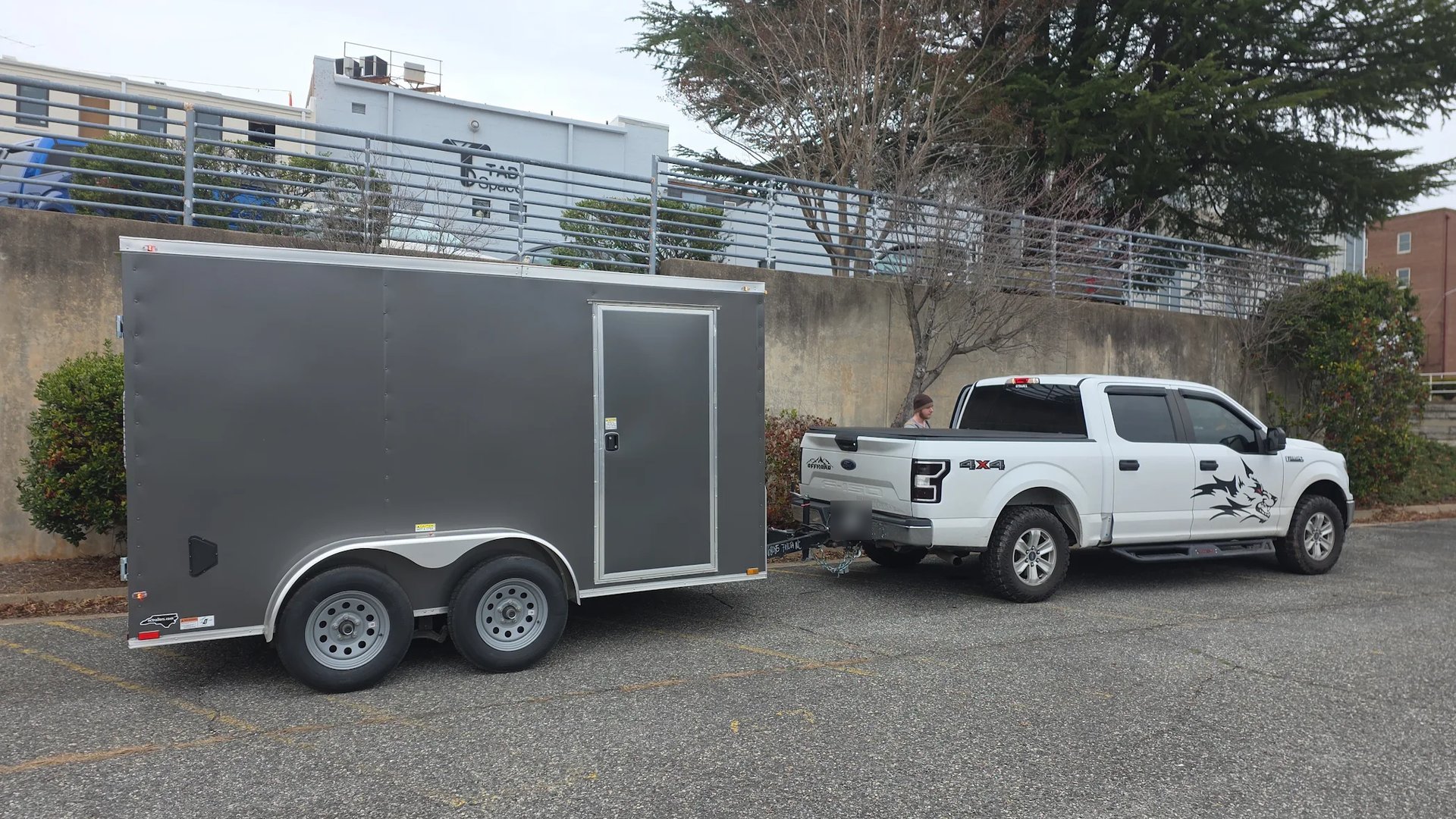
We carry both open and enclosed car haulers at both lots. The Alcom Cargo Pro Stealth enclosed car hauler is built from aluminum, which cuts the empty-weight penalty of going enclosed compared to a steel-framed trailer at the same GVWR. That gets you the protection of an enclosed trailer with more of your payload left over.
When a bumper-pull isn't enough
Bumper-pull car haulers top out around 14,000 pounds GVWR in most standard builds. If you are hauling multiple vehicles, heavy modified vehicles, or running a commercial transport operation that moves vehicles over 6,000 pounds on a regular basis, a gooseneck car hauler is the right call.
A gooseneck connects to a ball in the truck bed instead of a rear receiver. That shifts the tongue weight over the rear axle and lets the truck handle a lot more load. Gooseneck car haulers typically start at 14,000 pounds GVWR and go up from there. They need a gooseneck hitch installed in the bed and won't work with a standard receiver without an adapter.
We carry the Horizon Trailers lineup, including the upcoming Horizon CHZ car hauler, built for buyers who need car hauling capacity beyond what a bumper-pull can give them. Browse our car hauler inventory for current in-stock open and enclosed options.
Matching the trailer to your tow vehicle
The order that works is simple. First, figure out the weight of the vehicle you'll haul most often. Second, find trailer configurations that give you enough payload at a GVWR that fits that weight. Third, work out the expected tongue weight at 10 to 15 percent of the loaded trailer weight. Fourth, confirm your tow vehicle's tow rating, payload rating, and tongue weight limit all clear those numbers with margin to spare.
Buying a trailer and then finding out your truck can't safely tow it loaded is a common mistake, and an avoidable one. The ratings are on the door placard, the trailer VIN plate, and the manufacturer's spec sheet. Ten minutes spent checking them before you buy is time well spent.
Car hauler options and financing at NC Trailers
We stock car haulers and tow dollies at Thomasville and Winston-Salem across the full range of open and enclosed builds. If you are financing, trailer financing is available for both personal and business buyers. If the trailer is for a commercial auto transport operation, ask our financing team about business loan programs and whether your purchase qualifies for a Section 179 deduction. That last part is a conversation for your CPA, but we can point you in the right direction.
If you have specific weight questions about a vehicle you plan to haul, especially modified vehicles, project cars, or anything without a standard published curb weight, bring that information when you visit. The team at either lot can confirm whether a given trailer gives you the payload margin you need before you commit to the purchase.
Not sure which car hauler has the payload you need?
Call us, stop by either lot, or fill out the financing request just below and we will get right back to you.
 About the Author