
The aluminum vs steel question comes up almost every week on the lot. The honest answer needs one clarification most buyers don't get up front: on enclosed cargo trailers, the exterior skin is almost always aluminum. The real question is what holds that skin together, the frame. That's where steel vs aluminum actually matters for weight, long-term maintenance, and how the trailer holds up where you store and use it.
Most "steel" enclosed trailers you see on the lot are steel-frame trailers wrapped in .030 aluminum sheet or .080 polycore aluminum. Cynergy Cargo, the Cynergy Cargo Pro Series, Quality Cargo, and most other mainstream enclosed brands are built that way. A small number of manufacturers still wrap a steel frame in steel sheet, but that's the exception, not the rule. The premium alternative is all-aluminum, frame and skin, which Cargo Pro (Alcom) builds, including the Stealth model line that several of our buyers come in asking for.
So when we say "aluminum vs steel enclosed trailer," we really mean aluminum-frame vs steel-frame. With the skin being aluminum on both, the real differences come down to what's underneath the skin.
What Aluminum and Steel Actually Mean in Enclosed Trailer Construction
Steel-frame, aluminum-skin (the most common build). Steel tubing or angle iron for the main frame, crossmembers, and uprights, wrapped in aluminum sheet (.030 or .080 polycore). This is what most of the enclosed trailers we sell are built like, including Cynergy Cargo and Quality Cargo. Steel is cheaper per pound and welds easily at any shop, which keeps the price down. The aluminum skin handles the weather while the steel frame does the structural work.
All-aluminum (frame and skin). Aluminum tubing for the frame, crossmembers, uprights, and the exterior skin. Cargo Pro and Alcom build this way, with the Stealth being one example we keep on the lot. Aluminum frames are lighter and immune to the rust that gradually eats steel frames at welds and fastener holes. They cost more, and aluminum is harder to weld well in the field if anything ever needs repair.
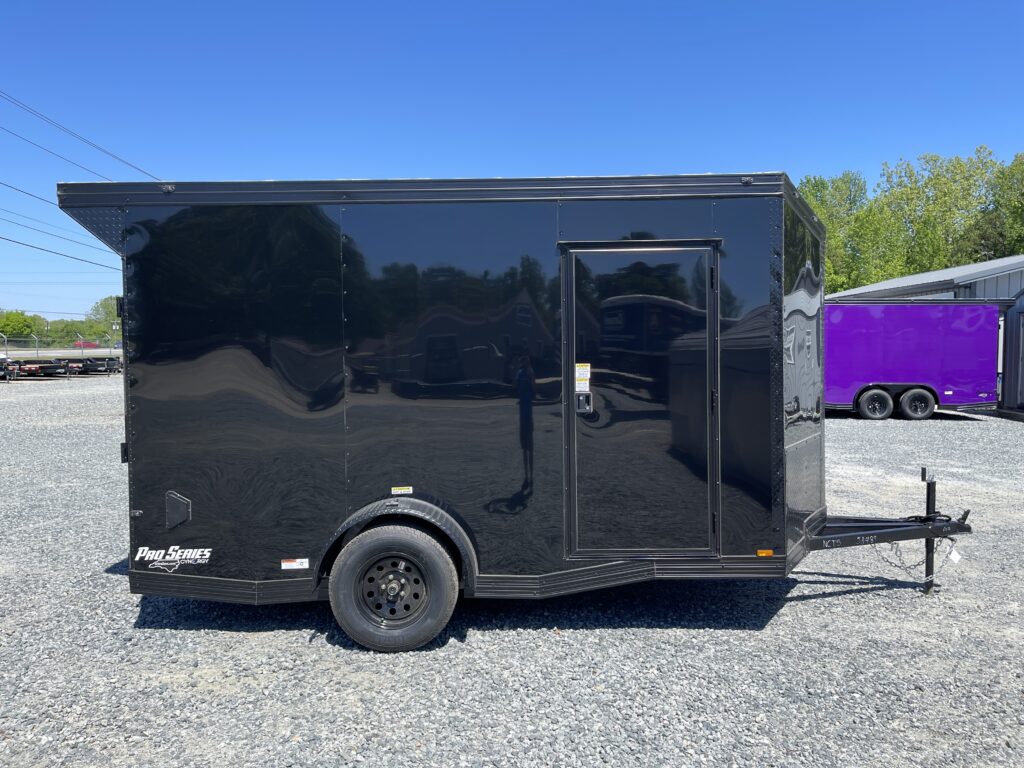
2026 Stealth 6x12 all-aluminum enclosed, single-axle, 2,990 lb GVWR. On the lot at the time of writing.
Side-by-Side: Enclosed Trailer Construction Types
| Factor | Steel frame, aluminum skin | All-aluminum (frame + skin) |
|---|---|---|
| Empty weight (6x12 single-axle) | ~1,400 to 1,700 lb | ~1,100 to 1,400 lb |
| Payload advantage | Baseline | 300 to 500 lb lighter |
| Skin material | Aluminum (.030 or .080 polycore) | Aluminum |
| Price (new, 6x12 single-axle) | $4,500 to $7,500 | $5,900 to $9,500 |
| Frame rust | Yes, especially at welds and fastener holes | None |
| Field repair | Steel welds at any shop; aluminum skin work is straightforward sheet repair | Aluminum frame welding requires a certified aluminum welder |
| Fuel economy | Baseline | ~1 to 2 mpg better at highway speed |
| Coastal / salt-belt life | Steel frame is the first thing to corrode | Holds up far better |
| Resale | Strong | Stronger, especially in salt regions |
| Best for | Most contractors, landscapers, racers, weekend haulers | Coastal / salt-belt buyers, payload-sensitive towing, long-term owners |
How Much Weight Actually Comes Off
On a 6x12 single-axle enclosed trailer, going all-aluminum saves about 300 to 500 pounds over the same trailer with a steel frame. The exact number depends on the manufacturer and how the frame is built, but that's the realistic range we see. On a half-ton tow vehicle that's already close to its payload limit (the trailer's tongue weight counts against your truck's payload, not its tow rating), 400 pounds back in your favor matters. On an 8.5x20 or 8.5x24, the savings climb proportionally, often into the 600 to 900 pound range.
If your truck has plenty of payload to spare, the weight savings just translate into a small fuel-economy gain and easier maneuvering at low speed. Either way, it doesn't hurt.
Long-Term Maintenance and Where You Store the Trailer
This is the part of the conversation most buyers skip over and regret later. Aluminum-frame trailers have a real long-term advantage anywhere road salt, coastal humidity, or constant rain shows up. The northeastern US, the Carolina coast, and anywhere with winter road treatment all do the same thing to a steel frame: rust starts at every weld, every fastener hole, every spot where the protective coating gets scratched. You can rinse it, paint it, undercoat it, and slow the rust down, but you cannot stop it.
An aluminum frame doesn't have that problem. It oxidizes (the white powder you see on older aluminum), but the oxide forms a self-passivating layer that protects the metal beneath. The frame stays structurally sound for decades.
If you haul once a month and the trailer lives in a dry barn in the Piedmont, a steel frame is fine. If the trailer lives outside year-round, sees salted roads in winter, or spends time near the coast, the all-aluminum tradeoff pays off in five to ten years of reduced maintenance and a frame that doesn't quietly weaken at welded joints.
Resale Value
All-aluminum enclosed trailers hold their value better, especially in coastal and northeastern markets where buyers know what salt does to steel. On the used market, a 10-year-old all-aluminum trailer in good condition typically commands a higher percentage of its original price than a 10-year-old steel-frame trailer of similar size, because the structural integrity hasn't degraded the same way.
In a typical Piedmont resale market the difference is smaller but still meaningful.
When All-Aluminum Is the Right Buy
- You're towing with a half-ton or smaller and pushing payload limits
- The trailer will live outside or store somewhere humid
- You're in the salt belt or near the coast
- You plan to keep the trailer ten or more years
- Resale value matters to you
When Steel-Frame, Aluminum-Skin Is the Right Buy
- You're price-sensitive on the up-front cost
- You have plenty of tow vehicle payload to spare
- The trailer stores in a dry barn or covered space
- You're not in the salt belt
- You're planning to use it heavily for five to seven years and move on
What We Keep on the Lot
NC Trailers carries the steel-frame, aluminum-skin enclosed trailers most buyers come in looking for: Cynergy Cargo and the Cynergy Cargo Pro Series, plus Quality Cargo. On the all-aluminum side, we carry Cargo Pro (Alcom), including the Stealth model line for buyers who want the blacked-out aesthetic on top of all-aluminum construction.
If you want to walk through both construction types in person, stop by Thomasville at 336.276.0329 or Winston-Salem at 336.499.9888. We can put a Cynergy Pro and a Cargo Pro side by side and let you see the difference in framing, in skin attachment, and in how each one holds up at the seams. For most buyers, the right answer comes from looking at the two, not from reading specs.
Still deciding between aluminum and steel?
Call us, stop by either lot, or fill out the financing request just below and we will get right back to you.
 About the Author