

An equipment trailer is an open deck trailer built to haul heavy rolling machines: skid steers, mini excavators, tractors, compactors, lifts. There is no roof, no walls, and no doors. What you get instead is a flat deck, a way to get the machine onto it, and enough axle under it to carry the weight legally.
Most people buy one for rolling equipment, but that is not the only job it does. The same deck hauls lumber, pipe, block, and anything else that comes on a pallet and goes on with a forklift. You do not have to drive something onto an equipment trailer to make it useful, and most of them handle both kinds of work.
Here is what actually separates one equipment trailer from another, and what to look at before you buy.
Deck Width: Between the Fenders or Over the Tires
Equipment trailers come two ways, and this is usually the first decision.
Fender style, roughly 82 to 83 inches of usable deck. The deck sits between the tires and you get fenders on both sides. The trailer rides lower, which means a shallower load angle and a lower center of gravity. The tradeoff is that the fenders limit your width, so anything wider than about 83 inches hangs over them.

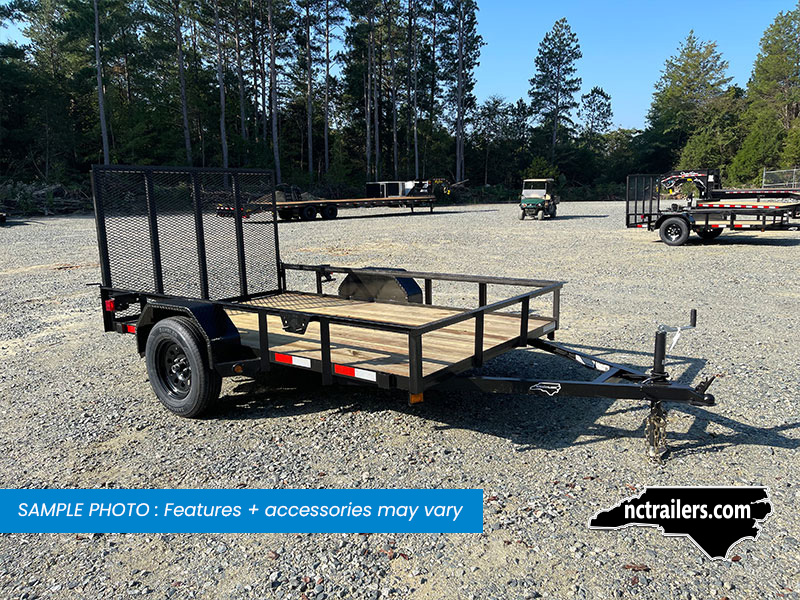
Fender style: the deck runs between the tires, so the trailer sits lower and loads at a shallower angle. Two-inch treated boards and stand-up ramps at the rear.
Deckover, 102 inches wide. The deck runs over the top of the tires, giving you the full 102 inches of legal width with nothing in the way. That is what you want for a wide machine, a skid steer with a big bucket, or palletized material you want to set down anywhere on the deck. The trailer sits higher, so the load angle is steeper unless the trailer has a tilt or a dovetail to make up for it.

Deckover: the deck runs over the tires for a full 102 inches of width.
Nothing we sell is wider than 102 inches, because that is the legal limit without a permit.
How the Machine Gets On the Deck
This is the part buyers underestimate, and it is the part you deal with every single load. There are four approaches.
Ramps. The most common setup. Slide-in ramps store in tubes under the deck and pull out when you need them. Stand-up ramps fold up vertically at the rear. Mega ramps are longer and wider, and they exist because low equipment needs a shallower climb. Ramps are simple and cheap to replace, but you are handling heavy steel by hand on every load.
Full tilt. The entire deck pivots and lowers to the ground, so the whole trailer becomes the ramp. You get the shallowest load angle available and you never touch a ramp. The catch is that the deck tilts under weight, so you load one machine at a time and you need to think about where the weight sits as it crosses the pivot.
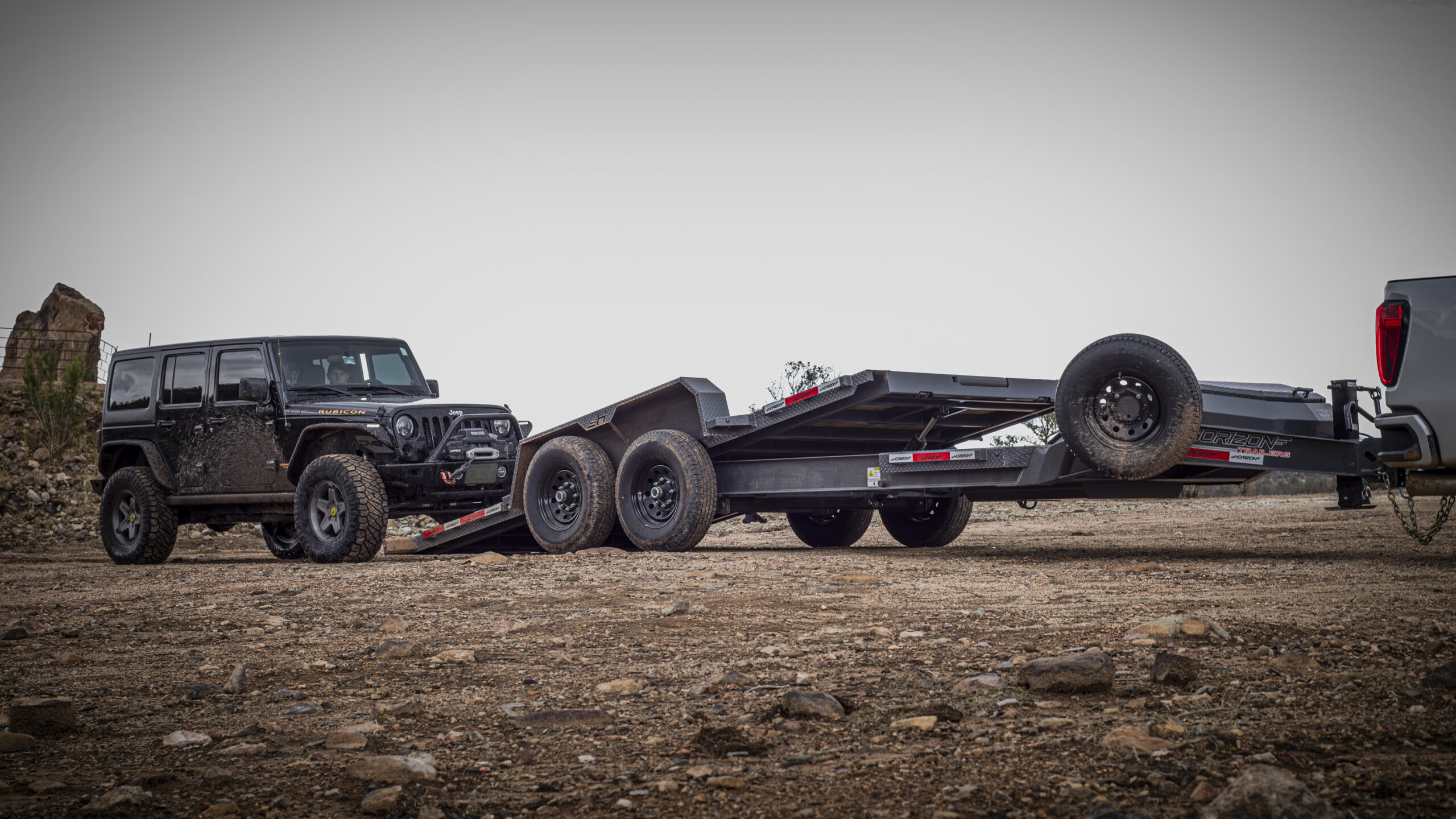
Full tilt: the whole deck goes to the ground, so there are no ramps to handle.
Partial tilt. The front section of the deck stays flat and fixed while the rear section tilts down. That fixed front section is the point. You can leave a machine, a toolbox, or material parked up front and still tilt the back to load something else. A 60/40 split is typical.
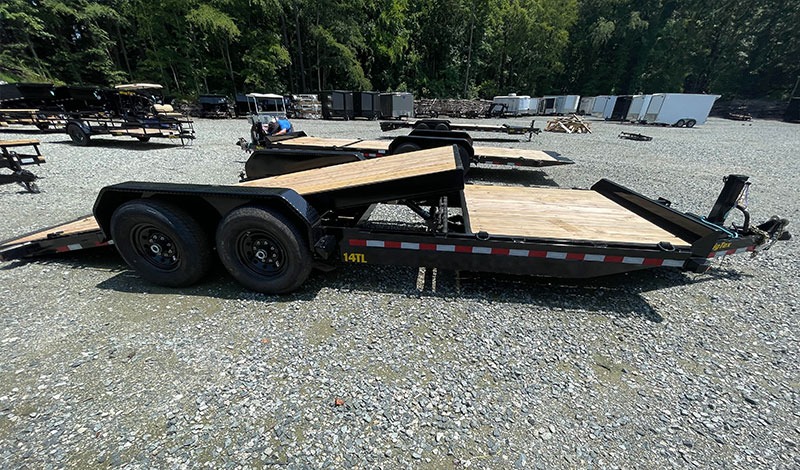
Partial tilt: the front deck stays flat while the rear tilts, so you can keep a load up front.
Tilt decks come two ways underneath, and it matters. A gravity tilt has no pump and no electrical system. The weight of the machine tips the deck, and a hydraulic dampening cylinder controls how fast it goes down and back up. Fewer parts, nothing to charge, nothing to fail. A power tilt uses an electric motor driving a hydraulic pump, so you run the deck up and down on a switch regardless of what is on it. More convenience, more to maintain, and a battery you have to keep charged.
Hydraulic dovetail. The rear section of the deck folds down hydraulically and sits flat on the ground, then folds back up level with the deck once you are loaded. You get a low load angle with no manual ramp handling and no tilting deck under the machine, and when it is folded up you have a full flat deck for materials. It is the most capable setup and the most expensive.
Straight deck. A flat deck with no ramps, no tilt, and no dovetail. There is no way to drive a machine onto it. These are for loads that get set on with a forklift or a crane, which covers a lot of construction material and palletized freight. If you buy a straight deck expecting to load a skid steer, you have bought the wrong trailer.
| Loading style | How it works | Best for | Watch out for |
|---|---|---|---|
| Ramps | Slide-in, stand-up, or mega ramps you set by hand | General use, lowest cost | Manual handling on every load; steep angle on a deckover |
| Full tilt | The whole deck pivots to the ground | Lowest load angle, no ramps to handle | Deck moves under weight; one machine at a time |
| Partial tilt | Rear section tilts, front stays fixed | Keeping a load or toolbox up front while you load the back | Shorter usable tilt area than a full tilt |
| Gravity tilt | Weight tips the deck, a dampening cylinder controls the speed | Simplicity, nothing electrical to fail | You need weight on the deck to bring it down |
| Power tilt | Electric motor and hydraulic pump raise and lower the deck | Loading on a switch, loaded or empty | Battery upkeep and more components |
| Hydraulic dovetail | Rear deck folds to the ground, then folds up flat | Low angle plus a full flat deck for materials | Highest price and the most hydraulics |
| Straight deck | Flat deck, no loading mechanism at all | Forklift or crane loading, materials and pallets | You cannot drive equipment onto it |
Deck Material
Forget plywood. That is an enclosed trailer floor and you will not find it on an equipment trailer.
Two-inch treated wood is what most equipment trailers ride on. It takes tracks and outriggers, it does not get slick the way steel does, and when a board finally gives up you pull that board and put a new one in. Treated pine is the standard.
Oak shows up on the really heavy duty trailers. It is denser and harder than pine and it holds up better under steel tracks and repeated point loading. It costs more, and on a heavy trailer it is worth it.
Steel decking is available on some equipment trailers. It will not rot and you can weld to it, but it rusts where the coating gets scraped off, and it gets genuinely slippery when it is wet or muddy. If you go steel, think about how your machine behaves on a wet deck at an angle.
When you inspect any wood deck, push on the boards where they cross the crossmembers. That is where water sits and rot starts, and a board that flexes there is telling you something the top surface is not.
Bumper Pull or Gooseneck
Most equipment trailers are tag alongs, also called bumper pulls. They hitch to a ball on the back of the truck, and on an equipment trailer that ball is almost always a 2-5/16 inch. Some are set up for a pintle coupler instead, which is a hook and lunette ring rather than a ball. Pintles are common on municipal and heavy construction fleets because they tolerate more slop and articulation on rough ground. Know which one your truck is set up for before you buy, because they are not interchangeable.
Goosenecks hitch to a ball in the truck bed, over the rear axle. The advantage is handling rather than raw capacity. Putting the pin over the drive axle instead of behind the bumper gives you better stability, less sway, and much better backing. On longer and heavier equipment trailers, that difference is the whole reason to go gooseneck.
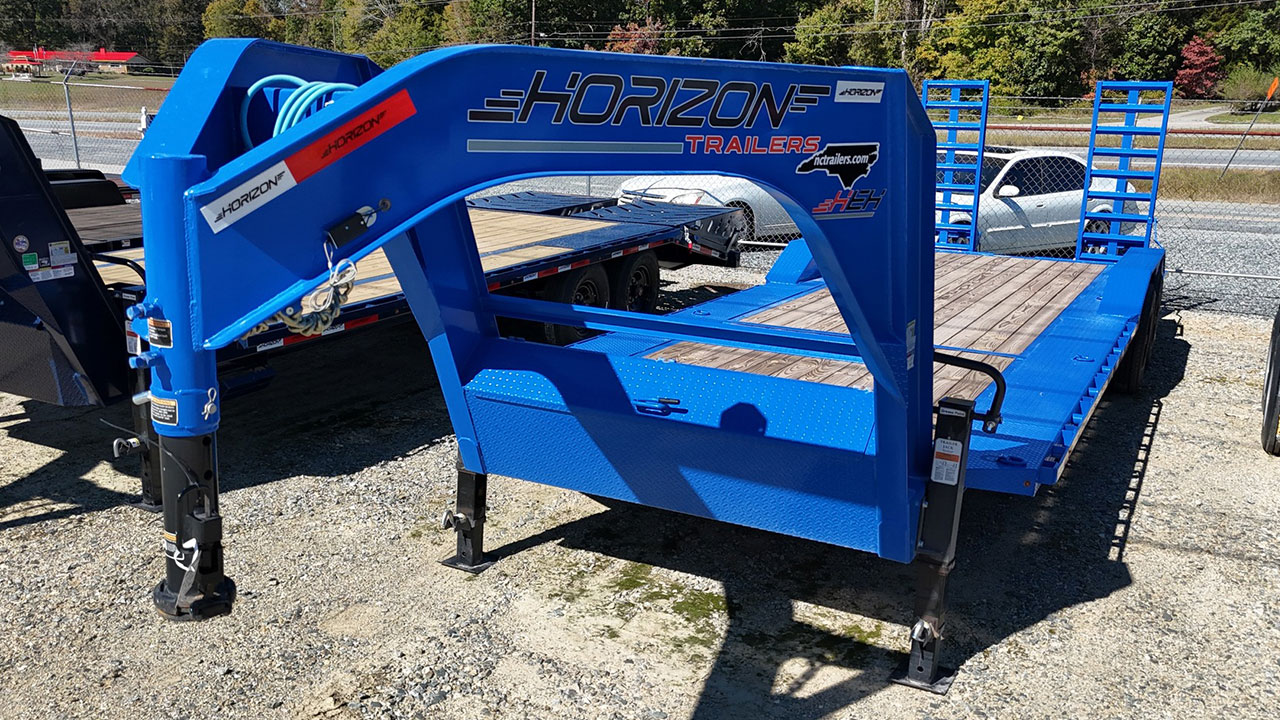
A gooseneck equipment trailer hitches over the truck's rear axle, which is what makes it tow and back better.
GVWR, Axles, and What You Can Actually Carry
GVWR is the loaded limit for the trailer, not your payload. Subtract the trailer's own empty weight and what is left is what you can put on the deck. The equipment trailers on our lot run from 7,000 up to 21,000 pounds GVWR, which spans a small tandem for a compact tractor all the way to a heavy deckover built for full size machines.
Weigh your machine before you shop, and weigh it the way you actually haul it. A bucket, a set of forks, a full fuel tank, and an operator's toolbox add up faster than people expect, and a trailer rated correctly for a bare machine can be over its limit once everything rides along. Then check what your truck is rated to pull against that loaded number, not against the trailer's empty weight.
Federal Safety Inspections
This one catches people. A federal safety inspection, also called the annual DOT inspection, is required on a trailer used commercially if either of these is true: the trailer crosses a state line for work, or the trailer has a GVWR over 10,000 pounds. Most equipment trailers clear 10,000 pounds easily, so if you are using one for business, plan on needing the inspection.
It is an inspection of the trailer itself. Your truck being compliant does not cover it. It runs annually, and the sticker goes on the trailer tongue. We include a federal inspection with every trailer we sell, and we can do them on a trailer you already own as a service visit. There is more detail on our federal safety inspection page.
What to Check Before You Buy
Whether the trailer is new or used, these are the things worth putting your hands on.
| What to check | What you are looking for | Why it matters |
|---|---|---|
| Deck boards | Soft or flexing boards over the crossmembers, splits, rot at the ends | A full deck replacement is the most common big repair on a used equipment trailer |
| Loading setup | Ramps straight and latching, tilt deck cycling smoothly, dovetail seating flat | You use it every load, and a bent ramp or a leaking cylinder is not cheap |
| Deck width vs. your machine | 82 to 83 inches between fenders, or 102 inches deckover | A wide bucket on a fender trailer will not sit right |
| GVWR vs. loaded machine | Payload left after subtracting the trailer's own weight | Attachments and fuel push you over the rating quickly |
| Coupler type | 2-5/16 ball, pintle ring, or gooseneck, matched to your truck | They are not interchangeable |
| Brakes | Even stops with no pull; magnets not worn smooth or cracked | Loaded equipment does not stop on truck brakes alone |
| Tire date code | Six years or newer, no sidewall cracking | Tread depth tells you nothing about the age of the rubber |
| Welds at the tongue or neck | Cracks, bends, evidence of old repairs | The highest stress joint on the trailer |
| Suspension and bearings | Cracked or shifted leaves, worn shackles, roughness when you spin a wheel | Cheap now, expensive on the shoulder of the highway |
| Tie-down points | D-rings welded to the frame rather than sheet metal, stake pockets, rub rail | Securement is a legal requirement, not a preference |
Come Tell Us What You Haul
We stock equipment trailers from Maxx-D, RawMaxx, Nolan, Superior Trailers of GA, Southland, and more, at both the Thomasville and Winston-Salem lots, in bumper pull and gooseneck, from 7,000 up to 21,000 pounds GVWR, with ramps, tilt, and hydraulic dovetail decks.
The fastest way to get this right is to tell us the machine you haul, what it weighs with its attachments on, and what you are pulling it with. We will narrow it down from there. Browse the current equipment trailer inventory, or call Thomasville at (336) 475-5054 or Winston-Salem at (336) 499-9888.
 About the Author