
Shopping small trailers starts with one question, and it is not about the trailer. What can your vehicle actually pull? An SUV, a crossover, or a half-ton pickup will tow a real trailer, but the margin is thinner than it is behind a three-quarter-ton, and going a little over changes how the vehicle handles, brakes, and holds up. NC Trailers carries lightweight models built for exactly this, and reading your own vehicle's numbers is step one.
Do not judge by size. A compact trailer loaded with something dense like gravel or wet mulch weighs far more than it looks, and that is where people get themselves in trouble.
Reading Your Tow Vehicle's Rated Towing Capacity
Where to Find the Number
Maximum towing capacity is in the owner's manual and often on a sticker in the driver's door jamb. It is not the number on the window sticker from the dealership. That rating reflects the vehicle as it was originally equipped, so if a hitch got added later or the tires changed, confirm the rating still applies to your setup instead of assuming.
Payload vs. Towing Capacity
These are two different numbers and both of them can stop you. Towing capacity is what the vehicle can pull. Payload is what it can carry, including passengers, cargo, and the trailer's tongue weight. Tongue weight runs about ten to fifteen percent of the loaded trailer, and it lands on your payload, not your towing capacity. So a vehicle can be comfortably under its tow rating and still be over payload once you add a family and their gear on top of the tongue. Check both.
Lightweight Single-Axle Trailer Options
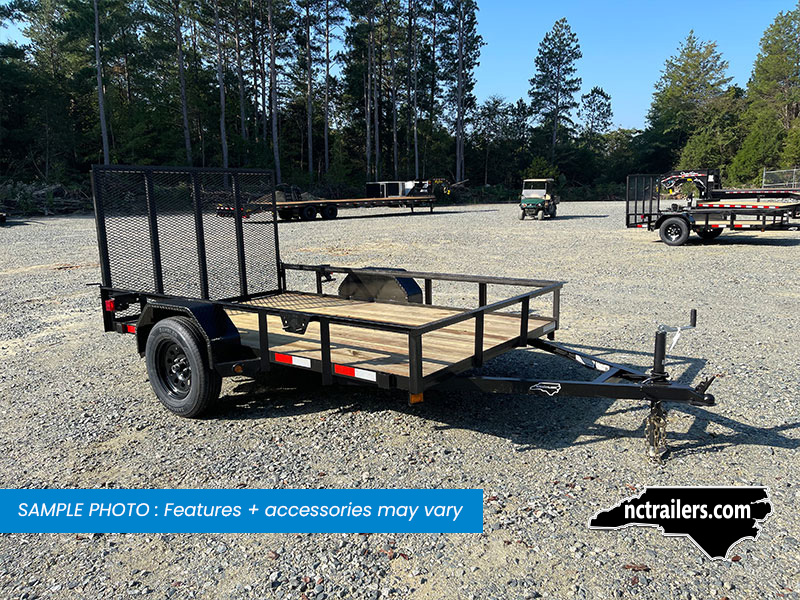
Most trailers built for compact tow vehicles are single axle, because a single axle keeps the trailer's own weight down and leaves more of your capacity for the load. Single axle utility trailers on our lot commonly come in at 2,990 lb GVWR, which covers light yard work, a riding mower, an ATV, or a modest load of material, and sits inside range for most SUVs and half-tons. Check the trailer's GVWR against your vehicle's rating rather than eyeballing the size.
Empty weight matters as much as GVWR. The trailer's own weight counts against your capacity before you load a thing, so a heavier-built trailer with the same GVWR leaves you less usable payload. Compare both numbers, and remember GVWR is the ceiling for the trailer plus everything on it, not a cargo allowance.
| Number | What It Means | Where to Find It |
|---|---|---|
| Tow rating | The most the vehicle can pull | Owner's manual, often the door jamb sticker |
| Payload | What the vehicle can carry, tongue weight included | Door jamb sticker |
| Trailer GVWR | The ceiling for the trailer plus its load | Certification label on the trailer |
| Trailer empty weight | Comes out of your tow rating before you load anything | Certification label or the spec sheet |
| Tongue weight | About 10 to 15 percent of the loaded trailer, counts against payload | Weigh it, or calculate from the loaded weight |
Hitch Class and Wiring Requirements for Smaller Trailers
Most compact tow vehicles come with a Class I or Class II receiver from the factory, and small utility trailers are built to work within those. Confirm your vehicle's hitch class and its rating before you assume, because some crossovers ship with a hitch rated below what the drivetrain could otherwise handle, and the hitch is the number that governs. Wiring is the other piece. Most small trailers use a four-pin flat connector, and many newer SUVs have that pre-wired or available as an add-on, while older or base-trim vehicles need a harness installed.
Ball size trips people up more than hitch class does. Small utility trailers commonly use a 1 7/8-inch or a 2-inch ball, and the wrong size by a fraction can let the coupler come off the ball under load. Check the coupler on the specific trailer rather than assuming it matches the ball already on your truck. We can sort out the ball, the mount, and the wiring here if it does not line up.
Common Small-Trailer Uses
A small trailer covers more ground than people expect. Mulch, brush, and the occasional load of gravel are the everyday jobs, along with moving a riding mower or a small ATV. Dump runs, picking up furniture, hauling supplies for a weekend project. All of it, without the size, weight, and towing demands of a full-size utility or equipment trailer.
One caution on the gravel: a single yard of gravel runs 2,800 to 3,400 lb. On a 2,990 lb GVWR trailer that is your entire rating in one scoop, before the trailer's own weight. Loose material fills a small trailer's rating long before it fills the bed.
Buying Small vs. Sizing Up
If your hauling is mostly light with an occasional bigger job, be honest about how often that bigger job actually comes around. A small trailer covers the routine work, and for the rare heavy weekend most owners borrow or rent something larger for the day rather than buying and storing a trailer that sits unused eleven months a year. That usually costs less over time than owning a trailer sized for jobs you face twice.
The other side of it: if that bigger job is turning up monthly, you are buying twice. Stepping up to a tandem now, or starting one on rent-to-own so the money goes toward owning it, beats replacing a trailer in a year. Bring us what you actually haul and we will tell you which way it points.
NC Trailers' Smallest Utility Trailer Models
We carry compact single axle utility trailers sized for SUVs, crossovers, and light-duty trucks, from Nolan, Maxx-D, Southland, and more. Browse the landscape and utility trailer inventory to compare sizes, and our guide to buying a utility trailer covers what else to check. We work with over 20 lenders and accept all credit types, so trailer financing covers most buyers, and rent-to-own with no credit check is there if it does not.
Not sure what your vehicle can safely pull?
Call us, stop by either lot, or fill out the financing request just below and we will get right back to you.
 About the Author