
If you're shopping enclosed cargo trailers for your business, you're not buying the way a weekend hauler would. A small business owner needs a trailer that protects tools and inventory from weather and theft, tows safely behind the vehicle already in the fleet, and holds up to being loaded and unloaded several times a week. This guide walks through how business buyers should size, configure, and secure an enclosed cargo trailer, what customization options are worth considering, and what to expect when financing one as a business purchase.
How Small Businesses Actually Use Enclosed Cargo Trailers
Most business buyers fall into a few common patterns. Contractors use an enclosed cargo trailer as rolling tool storage, keeping ladders, power tools, and materials locked up between job sites instead of loaded loose in a pickup. That alone cuts out the time lost every morning reloading gear that came out of the truck the night before. Mobile vendors convert a cargo trailer into a retail space for pop-up sales, farmers markets, or seasonal storefronts, often building out a service window and counter space along one wall. Service businesses like mobile detailing, pressure washing, or pet grooming outfit a trailer as a self-contained workstation with water tanks, generators, or grooming equipment mounted inside so the whole operation travels together. What all of these have in common is that the trailer has to be sized and configured around the gear it will actually carry and the way the business actually runs, not picked off the lot because it looked about right.
Sizing an Enclosed Cargo Trailer for Your Business
Enclosed cargo trailers at NC Trailers span the steel-framed Cynergy Cargo and Quality Cargo lines and the all-aluminum Cargo Pro line from Alcom. They range from 5x8 single-axle units up to 8.5x24 tandem-axle models and larger. The small single-axle trailers work well for a solo tradesperson carrying hand tools and light equipment. The larger tandem-axle models suit crews hauling generators, compressors, or bulk inventory.
Interior height matters as much as floor length for business use. Five-foot-wide trailers start around 5 feet of interior height. The 8.5-wide models run 6'3", 7 feet, and taller depending on how they're built. A few extra inches make a real difference if you're installing shelving or need to stand upright inside while you load.
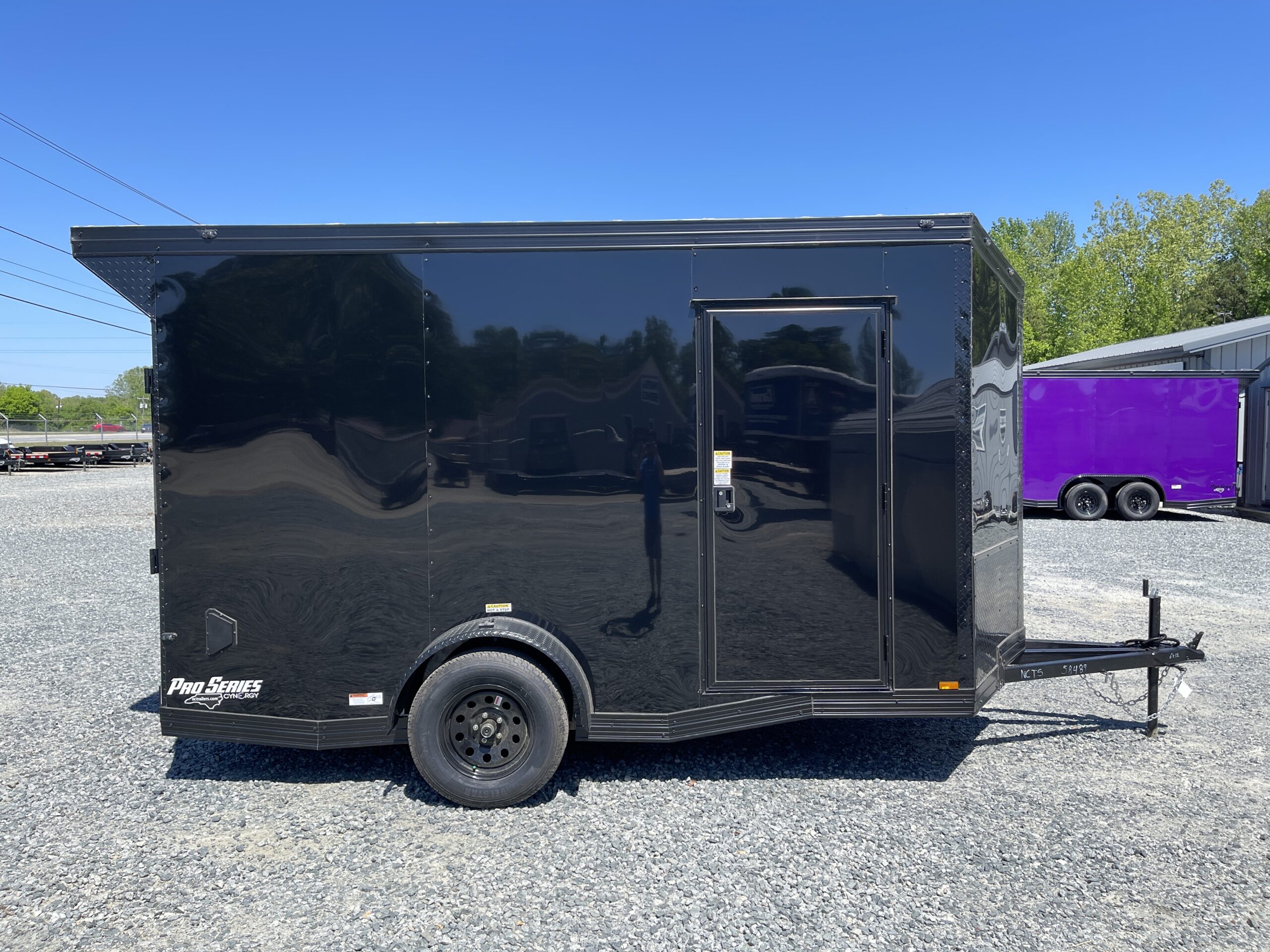
A 6x12 Cynergy Pro Series on the lot, a common size for a one-person crew.
| Size | Axles | Interior Height | Typical GVWR | Common Use |
|---|---|---|---|---|
| 5x8, 5x10 | Single | Starts around 5 ft | 2,990 lb | Solo tradesperson, hand tools, light gear |
| 6x10, 6x12 | Single or tandem | 6 to 7 ft | 2,990 to 7,000 lb | Rolling tool storage, one-person crew |
| 7x12 to 7x16 | Tandem | 6'3" to 7 ft | 7,000 lb, up to 9,990 | Two-person crew, mowers, larger equipment |
| 8.5x16 to 8.5x24 and up | Tandem | 6'3", 7 ft, and taller | 7,000 to 9,990 lb | Full crew, generators, compressors, bulk inventory, mobile workstations |
One number buyers miss: the rear door opening is about 6 inches shorter than the interior height. If you need 6 feet of clearance to roll equipment in, you want closer to 6'6" of interior height, not 6 feet. Measure the tallest thing you load before you settle on a size.
Door Configurations That Matter for Business Use
A rear ramp door with an extension flap is the standard choice for loading wheeled equipment like generators, mowers, or hand trucks, since the flap keeps the transition from ground to ramp from catching a wheel. A curbside side door gives you quick access to frequently used tools without opening the full rear ramp, which matters if you're in and out of the trailer a dozen times a day. A V-nose front end adds usable interior storage space up front and slightly improves towing aerodynamics compared to a flat-front trailer, though the difference is more noticeable on longer highway routes than short local runs. Matching the door configuration to how often you're getting into the trailer, and what you're loading, is worth more thought than most buyers give it upfront.
Security Features Worth Adding
An enclosed trailer full of tools or inventory is a target, and the base door hardware on most trailers is only a starting point. Many cargo models offer a bar lock upgrade that fits over the existing RV style door latch and adds a hasp for a padlock or disc lock, making unauthorized entry considerably harder than relying on the stock handle alone. A separate coupler lock, which secures the hitch itself, prevents someone from simply towing the trailer away when it's unhitched and left overnight at a job site or storage yard. Interior D-rings, standard on most enclosed cargo models, let you chain down high-value equipment inside the trailer as a second layer of protection beyond the locked door.
Weight Ratings and Matching a Tow Vehicle
A loaded enclosed cargo trailer needs to stay within both its own GVWR and the towing capacity of the vehicle pulling it. A 6x12 single-axle trailer at 2,990 pounds GVWR is manageable behind most midsize trucks and SUVs. An 8.5x24 tandem-axle model approaching 10,000 pounds GVWR can be towed with some half-ton trucks, but it's better suited to a three-quarter-ton or larger truck with a properly rated hitch and brake controller. Check your tow vehicle's rated towing capacity against the trailer's fully loaded weight, everything stored inside included, rather than going off the trailer's empty weight. For a business running several routes a week, that margin matters more than it does for occasional use, and it's worth being honest with yourself about what the truck in your driveway is actually rated to pull.
Customization Options Worth Considering for a Business Build
Beyond the base trailer, most of the models NC Trailers carries can be customized to fit a specific business rather than staying stock. Interior wall and ceiling finishing options turn a bare shell into a usable workspace, which matters if employees will be inside the trailer regularly rather than just loading and unloading it. Flooring choices, including RTP coated flooring or rhino liner, hold up better than plain plywood under repeated foot traffic and equipment being dragged in and out. Shelving, cabinetry, and E-track mounting rails let you organize tools and inventory instead of stacking everything loose, which cuts down on both damage and the time spent searching for a specific item mid-job. Talking through your actual workflow with us before you buy, rather than after, usually results in a build that needs fewer aftermarket additions later.
Financing an Enclosed Cargo Trailer as a Business Expense
Many small business owners finance an enclosed cargo trailer the same way they finance other equipment purchases, and some ask their accountant about deducting the cost as a business expense under Section 179 of the federal tax code, which allows qualifying business equipment to be expensed in the year it's placed in service rather than depreciated over several years. The specifics depend on your business structure and total equipment purchases for the year, so this is a conversation for your tax professional rather than something to assume applies automatically. On the financing side, NC Trailers, which operates as North Carolina Trailer Sales, works with buyers to structure terms around a trailer's use as a business asset, and applying online ahead of a visit can speed up the process considerably once you've narrowed down the size and configuration that fits your operation.
If you're ready to compare enclosed cargo trailer sizes and configurations for your business, browse the current enclosed trailer inventory at NC Trailers, review our general enclosed trailer buying guide for non-business considerations, or apply for financing online to get pre-qualified before visiting the Thomasville or Winston-Salem location.
Shopping for an enclosed trailer for your business?
Call us, stop by either lot, or fill out the financing request just below and we will get right back to you.
 About the Author