

Trailer leaf spring suspension: equalizers, bushings and spring types
Most trailers on the road ride on leaf springs, and on a tandem the springs are tied together by a part most owners never look at: the equalizer. This page explains how a leaf spring suspension works, the two kinds of leaf spring you will find under a trailer, why the pivot points wear, and what to look for before a worn part turns into a bent frame.
How a tandem leaf spring suspension works
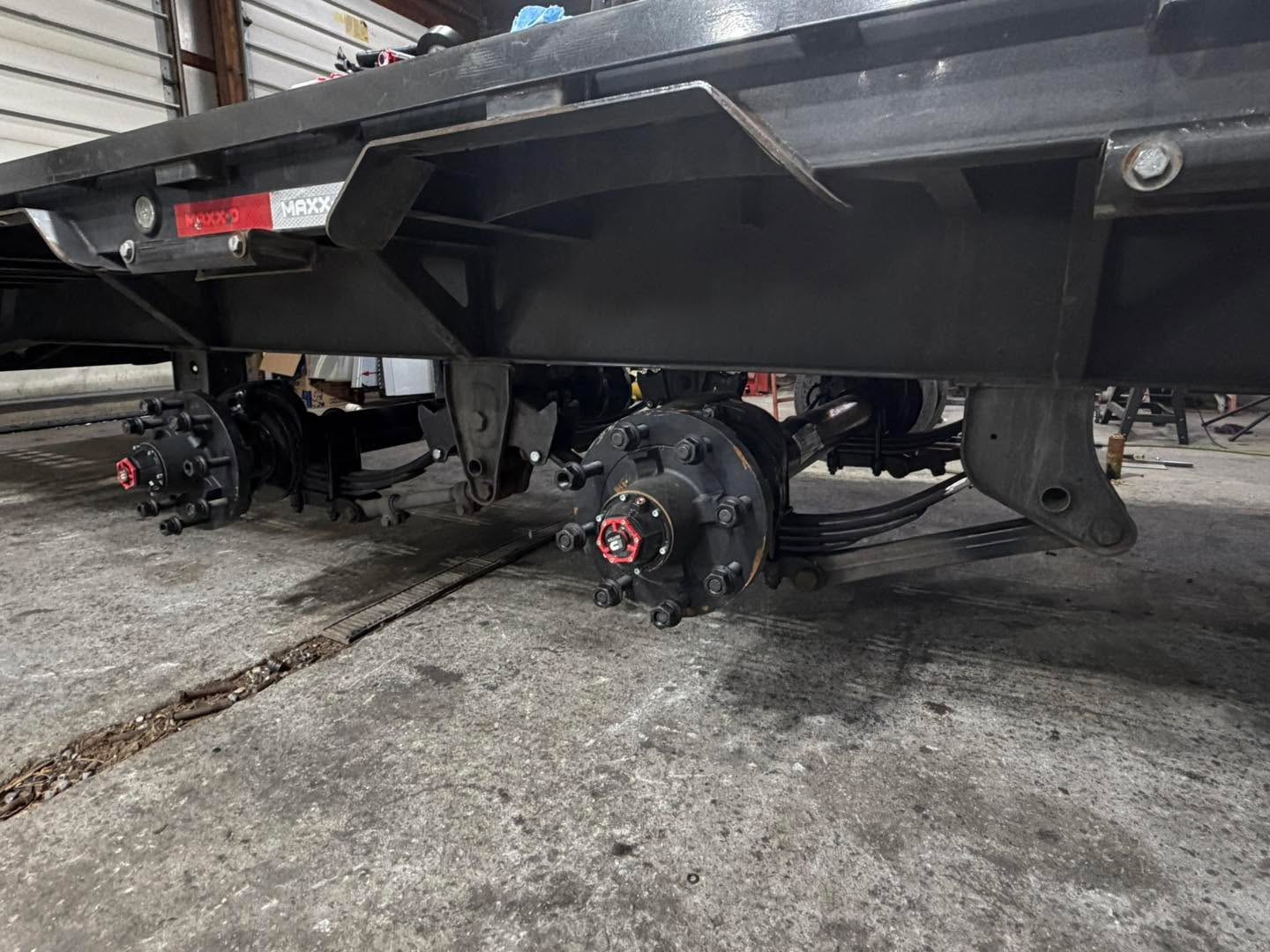
Each axle sits on a pair of leaf springs, held to the axle tube with U-bolts and tie plates. On a tandem, the springs hang from a front hanger, a center hanger between the axles and a rear hanger.
The equalizer is the pivoting piece that hangs from that center hanger and connects the rear of the front springs to the front of the rear springs. Dexter's service manual says the equalizer transfers instantaneous loads from one axle to the other, in an effort to "equalize" the load between them. Our service team explains it this way: when the front tire rolls over a bump, the equalizer tips like a seesaw so the rear axle stays on the ground instead of lifting off.
Torsion axles work differently. The suspension is built inside the axle tube and the axle bolts to the frame with its own brackets, so there are no leaf springs and no equalizer. Our leaf spring vs. torsion axle guide compares the two.
Double eye springs and slipper springs
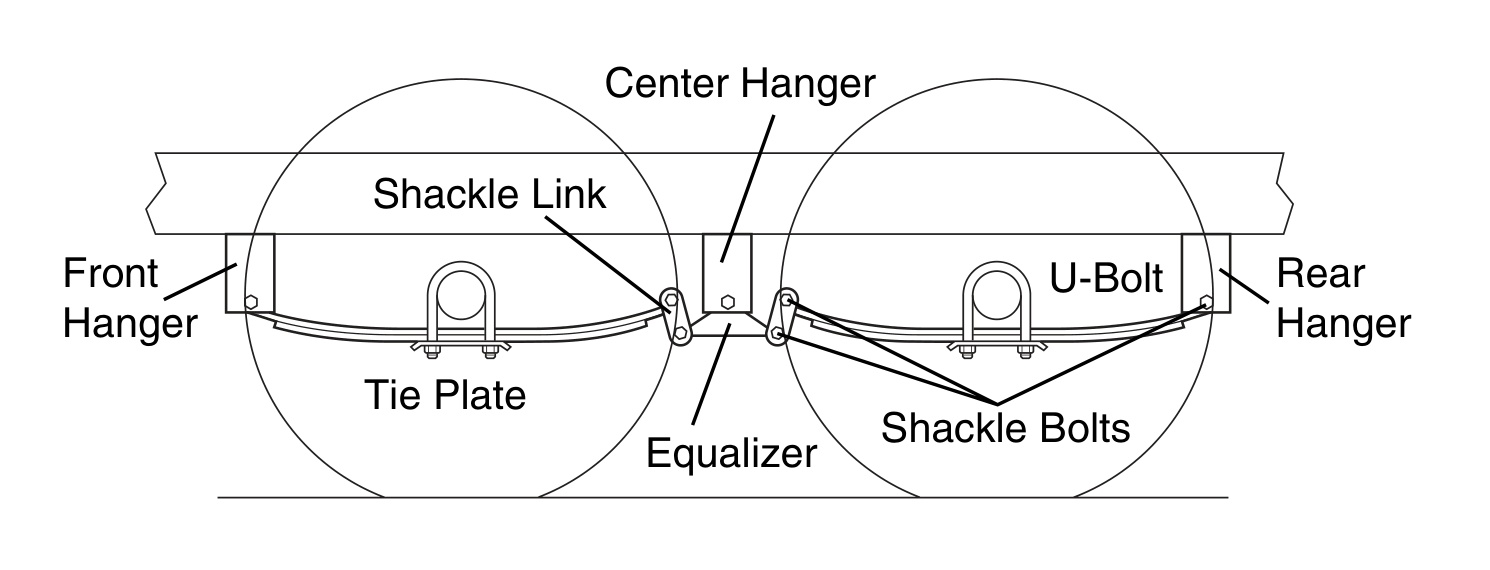
Double eye springs have an eye formed in each end, fitted with an anti-friction bushing. One end bolts into a hanger, and the other connects through short shackle links. Dexter explains that a spring gets longer as it is loaded, and the double pivot of the shackle links lets it do that freely.
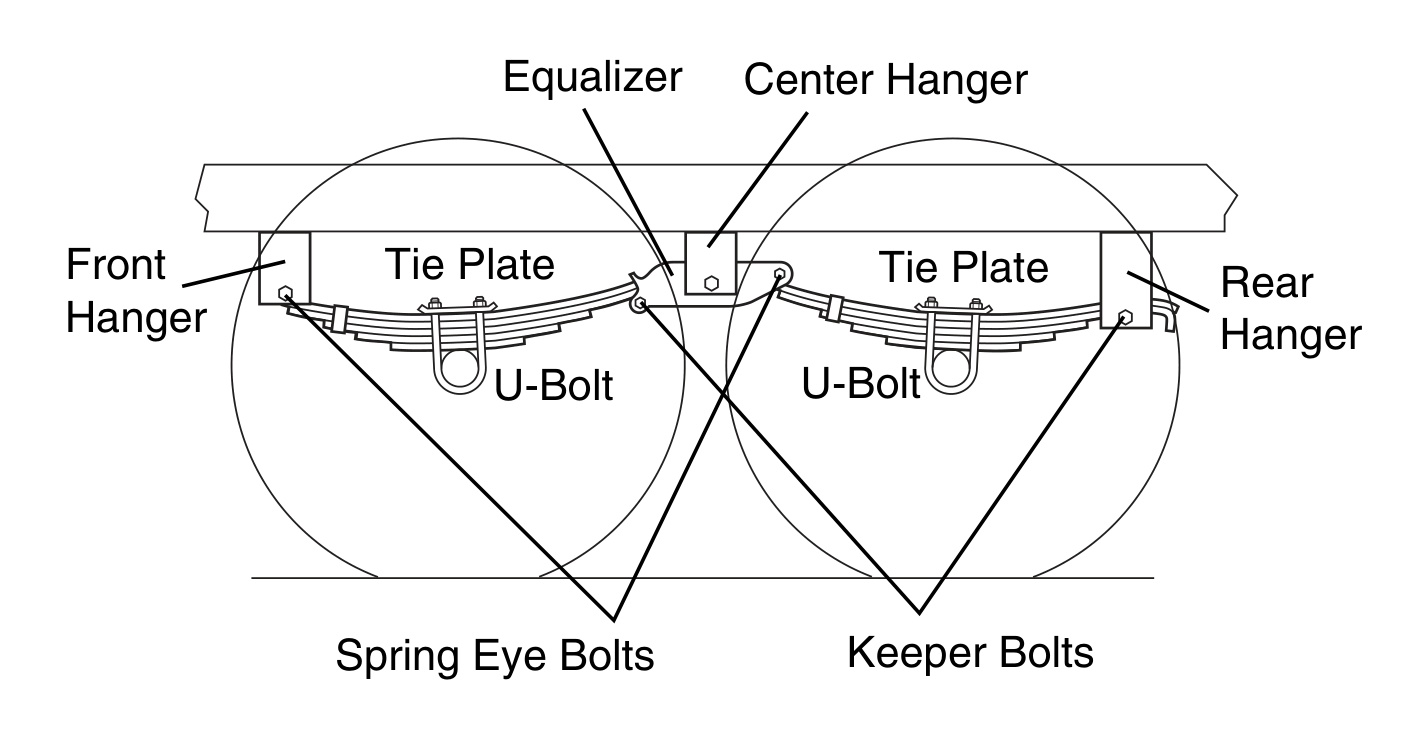
Slipper springs have an eye on the front end only. The rear end is formed into a reverse curve that rests in the rear hanger or the equalizer and slides against a wear surface there as the spring flexes. A keeper bolt runs under that end so the spring cannot drop out when the trailer is jacked up for service.
On our lots, slipper springs and heavier channel-style equalizers mostly show up under trailers with 7,000 lb axles and up, like heavier equipment and dump trailers. Lighter trailers usually run double eye springs. That is what our service team sees day to day, not a rule every manufacturer follows, so check the trailer in front of you.
Why equalizers and bushings wear out
The equalizer moves every time either axle moves, which on a trailer is constantly. Its bolts ride in bushings, and on most trailers those bushings are nylon from the factory. Dexter notes the standard pivot points are fitted with anti-friction materials that do not need routine greasing.
Over time the bushings wear through. Once they are gone, the bolt and the shackle links start cutting into the equalizer itself. Our service team has seen equalizers worn nearly in half, and has seen wear start within six months on landscape trailers that run every day. It is a wear item, like brake shoes or tires, and not a defect in the trailer.
There is an upgrade. Dexter sells heavy duty attaching parts kits for double eye suspensions on axles up to 8,000 lbs, with heavier shackle links, bronze bushings and bolts and equalizers that take grease. Our shop keeps bronze bushings in stock. If your trailer has greaseable suspension bolts, Dexter's schedule says to grease them and the equalizers every 3 months or 3,000 miles.
Signs your suspension needs attention
Worn suspension parts are hard to spot with the trailer sitting on its wheels. Our technicians usually find them once the trailer is lifted for an axle service and the suspension drops. A few things you can see from the ground:
- Uneven tire wear, especially one tire wearing on an edge.
- An axle that looks shifted or out of line with the other one.
- Springs touching the frame with the trailer empty. Our service team traces that back to a few causes: overloading, a broken leaf, a broken or bent hanger, a bent frame, or a worn equalizer letting everything shift.
- A spring that has lost its arch. Dexter's maintenance schedule lists loss of arch as something to inspect springs for, and says sagging or broken springs should be replaced. Our technicians put it simply: a healthy leaf spring should look like it is smiling at you.
- Bent parts, loose fasteners or stretched bolt holes. Dexter lists these for suspension parts, along with checking the welds on the hangers.
Dexter's schedule calls for a look over the suspension parts at least every 6 months or 6,000 miles. The easiest way to stay on it is your axle service. We inspect the suspension, tires and lights on every trailer that comes in for service, and we recommend axle service at 6 and 12 months in a trailer's first year, then every 12 months or 12,000 miles, whichever comes first.
Never jack a trailer up by the axle or equalizer
Dexter's warning is direct: do not lift or support the trailer on any part of the axle or suspension, and never put jack stands on the axle tube or the equalizers. Support the trailer on its frame, following the trailer manufacturer's guidelines, with jack stands rated for the load. Never go under a trailer that is not properly supported.
Heavy, daily use? Think about the running gear when you buy
Start with the rating. Buy a trailer rated to carry the heaviest thing you will ever put on it, and check the payload, not just the GVWR. Our GVWR and payload guide shows how to read both.
Then think about how hard the trailer will work. If it is going out every day for construction or landscaping, ask us about stepping up in axle capacity. Heavier running gear comes with larger tires, brakes and suspension parts, and our service team's experience is that it wears more slowly under the same load.
Think your suspension is worn? Call us. Our service department replaces springs, hangers, equalizers and bushings, and checks the suspension on every trailer that comes in.
Thomasville: (336) 276-0329
Winston-Salem: (336) 499-9888
Rather type than talk? Send us a message. Or see our axle service and axle and suspension repair pages.
Related guides
Sources
- Dexter, Operation Maintenance Service Manual, light duty axles, pages 64 to 68 (suspension systems), 80 (storage and jack stands) and 83 (maintenance schedule).
- NC Trailers Parts & Service team, from inspections and repairs in our own shop.