

Radial vs. bias-ply trailer tires: how to tell them apart and which one fits your trailer
Two trailer tires can be the same size and the same load range and still be built in two very different ways. One is a radial and one is a bias-ply tire. This page shows how to tell which kind is on your trailer, what each one is built for, and the replacement rule that matters most.
Everything below comes from the manufacturers' own documents: Carlstar, which makes the Carlisle trailer tires pictured, and the owner's manuals from Nolan Manufacturing, the trailer builder in Denton, NC. They are listed at the bottom of the page.
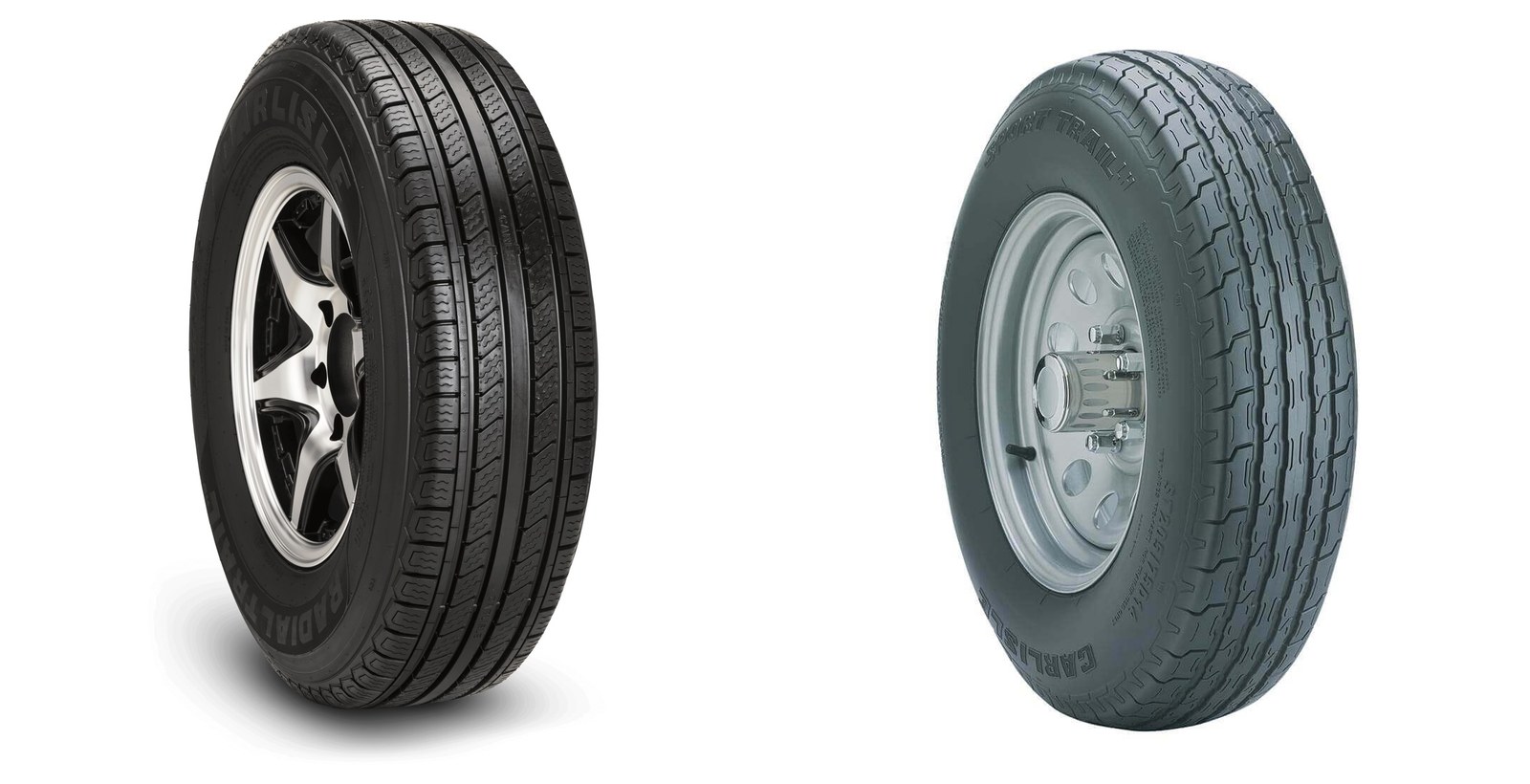
How to tell which one you have
Read the size printed on the sidewall. The letter just before the rim diameter tells you how the tire is built. Carlstar's tire FAQ puts it this way:
- R means radial. The belts run at 90 degrees.
- D means diagonal, which is a bias tire. The belts run diagonally from bead to bead at about 45 degrees.
So a tire marked ST205/75R15 is a radial. The same size with a D in place of the R is a bias-ply tire. The ST at the front stands for Special Trailer, which Nolan's manual describes as a tire for trailer use only.
How the two are built
Nolan's dump trailer owner's manual gives the textbook definitions. In a bias-ply tire, the ply cords are laid at alternate angles substantially less than 90 degrees to the centerline of the tread. In a radial-ply tire, the ply cords are laid at substantially 90 degrees to the centerline of the tread.
Carlstar adds the detail on materials. Its radial trailer tires use polyester plies with crisscrossing steel belts underneath the tread. Its bias trailer tires use nylon cord plies that crisscross inside the tire at a 30 to 45 degree angle.
What each one is built for
Carlstar's guidance on choosing between them:
- Radial: long-haul towing, such as travel trailers, toy haulers, larger boats and livestock trailers. Carlstar says the construction gives a smooth ride and extends the life of the tire.
- Bias ply: local work in construction, agriculture, marine and utility use. Carlstar says the crisscrossed plies make a tough, rugged tire and increase sidewall puncture resistance.
Carlstar also notes that many owners don't know which construction is on their trailer and may be running the wrong tire for the way they use it. If you are not sure, the letter on the sidewall settles it in a few seconds.
The replacement rule: never mix them
Nolan's trailer manual is direct about this one. All tires on the trailer must match in size, load range and construction, and you should not mix brands, types or sizes. The manual warns that mismatched tires can cause uneven wear, overheating or failure.
In practice, that means if you decide to switch a trailer from bias-ply to radial, you replace the whole set instead of one tire at a time. It is also worth checking that your spare matches what is on the axles.
Check the pressure with a gauge, not your eyes
Nolan's dump trailer manual points out that with radial tires, it is usually not possible to spot under-inflation by looking at the tire. A radial can be low and still look normal, so keep a gauge with the truck.
Check pressure cold, which the manual defines as a tire that has not been driven on for at least three hours. The right pressure is set by the tire's load range, printed on the sidewall, and not by the wheel or the number of lugs. Our trailer tire pressure and lug nut torque guide walks through the load range chart.
Speed rating and tire age
Look for a speed symbol on the sidewall. Carlstar's FAQ says that if a trailer tire is not marked with one, the default speed rating is 62 mph.
Tread depth will not tell you how old a trailer tire is. Carlstar explains that trailer tires often sit for long periods under load, and the tire's internal structure can break down in a way you cannot see. To find the age, read the last four digits of the DOT code: week, then year. Nolan's manual gives the example 3197, the 31st week of 1997. Our guide to avoiding trailer tire hazards covers what to look for on an older tire.
Need tires for your trailer?
Not sure what is on your trailer now, or whether it fits the way you tow? Bring it by. Our service team handles trailer tire replacement, spare tires and tire mounts.
Thomasville: (336) 276-0329
Winston-Salem: (336) 499-9888
Rather type than talk? Send us a message and we will set up a time.
Related guides
- Trailer tire pressure and lug nut torque, the load range chart and Dexter's torque table.
- Buying the right trailer tires, why a trailer tire is not a car tire.
- Avoiding trailer tire hazards, dry rot, date codes and overloading.
- Pre-trip towing inspection checklist, where the tire check belongs.
- How to repack trailer wheel bearings, the job behind the wheel.
- Trailer service at NC Trailers.
Sources
- Carlstar, The Great Debate: Radial vs. Bias, for construction and recommended uses.
- Carlstar, Tire FAQ, for the R and D sidewall markings, the default speed rating and the note on tread and tire age.
- Nolan Manufacturing, Trailer Manual & Safety Checklist and Dump Trailer Owner's Manual, for the matching rule, the ply definitions, cold pressure and the DOT date code.