


Equipment trailers take a different kind of beating than anything else on the road. Instead of a static load riding quietly to a job, they carry skid steers, mini excavators, and compact tractors that get driven or winched on and off most days. That concentrates wear into a handful of specific spots, and those are exactly the spots nobody checks until something lets go. We see the same equipment trailer problems come through our service bays in Thomasville and Winston-Salem over and over. Here is what to watch.
These problems develop slowly, which is why they catch people out. A ramp that flexes a little more than it used to, or a hinge that feels a bit looser than last month, does not feel urgent in the middle of a busy week. Checking a few specific points on a schedule is the whole difference between catching it early and finding out on a job site.
Quick Reference: What to Check and How Often
The ones with a number attached go on a calendar. The rest are look-and-feel checks that take a couple of minutes at the start of a haul.
- ✔ Wheel bearings: repack at 6 months and 12 months in the first year, then every 12 months or 12,000 miles, whichever comes first. A trailer that runs near its rating should be checked on that schedule without fail.
- ✔ Lug nuts on a new or freshly serviced wheel: re-torque at 10, 25, and 50 miles. That is Dexter's spec in Product Bulletin 409, and it is tighter than the "first 50 to 100 miles" you will see repeated in a lot of places.
- ✔ Torque value: set by wheel and stud size, applied in three stages in a star pattern. A 16 inch wheel on 9/16 studs is 140 to 170 ft-lbs. The 17.5 inch hub piloted wheels under the heavier equipment trailers are 275 to 325. Our tire pressure and lug torque page has the full table.
- ✔ Tire pressure: read it off the sidewall load range, cold. Do not use a chart that maps lug count to PSI. Load range letters have sub-categories that disagree with each other, D1 is 65 psi where D2 is 50, and guessing low is the top cause of trailer tire failure.
- ✔ Annual federal safety inspection if the trailer works for a living and is over 10,000 lb GVWR, or crosses a state line for work.
- ✔ Every haul: ramps and hinges, deck boards and fasteners, every tie-down point, and a hand on each hub after the first short stop.
Ramp and Hinge Wear from Repeated Heavy Loading
Ramp Wear Points
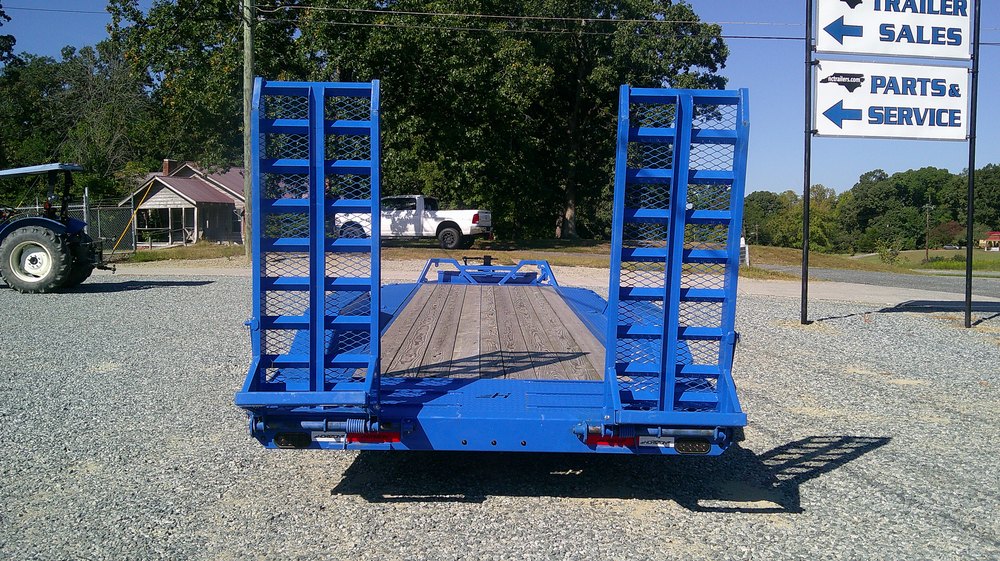
Ramps take steel tracks and tires directly, every load and every unload, and they wear faster than anything else on the trailer. Look for deep grooves, bent or cracked ramp edges, and cracking in the welds at the ramp base. A ramp that flexes noticeably while equipment is on it has already lost structure, and that gets inspected before the next load, not after.
Hinge and Pivot Wear
Fold-down and dovetail ramps ride on hinge pins and pivots that see thousands of cycles. Grease them on a schedule and watch for a hinge that has developed play, meaning the ramp wobbles side to side when it should only move up and down. Elongated pin holes or a pin worn visibly thin means new hardware, not more grease.
Deck Wear Under Tracks and Point Loads
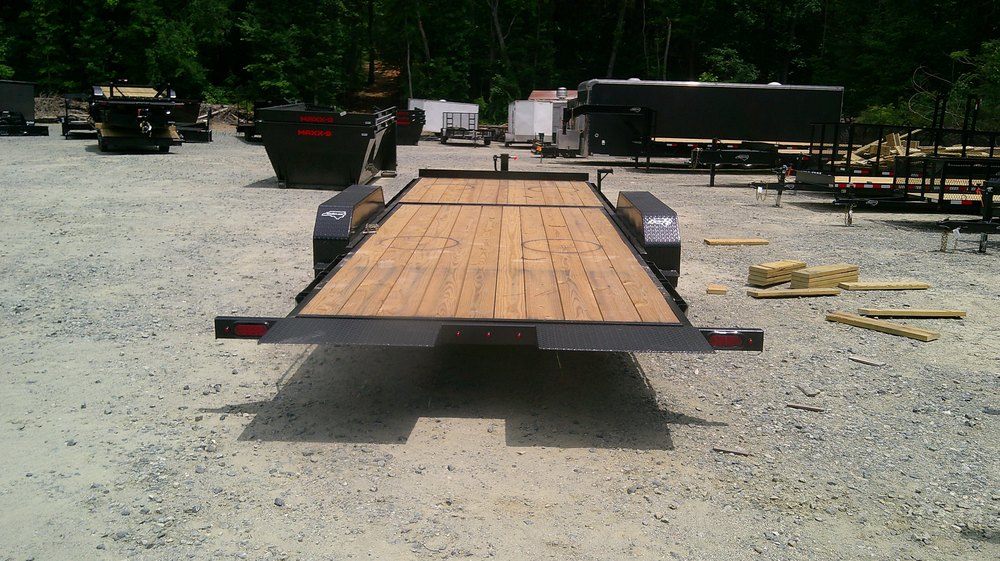
Most equipment trailer decks are 2-inch treated wood, and on the heavy duty units you will find oak, which is denser and takes steel tracks and point loading better. Some trailers run steel decking. Whatever yours is, the deck is a wear item. Check for boards that have gone soft, split, or started to lift from the crossmembers, and look at the fasteners while you are down there. On a steel deck, look for dishing where a machine has parked in the same spot for years and for surface rust turning into pitting.
Axle and Suspension Stress Under Max-Rated Loads
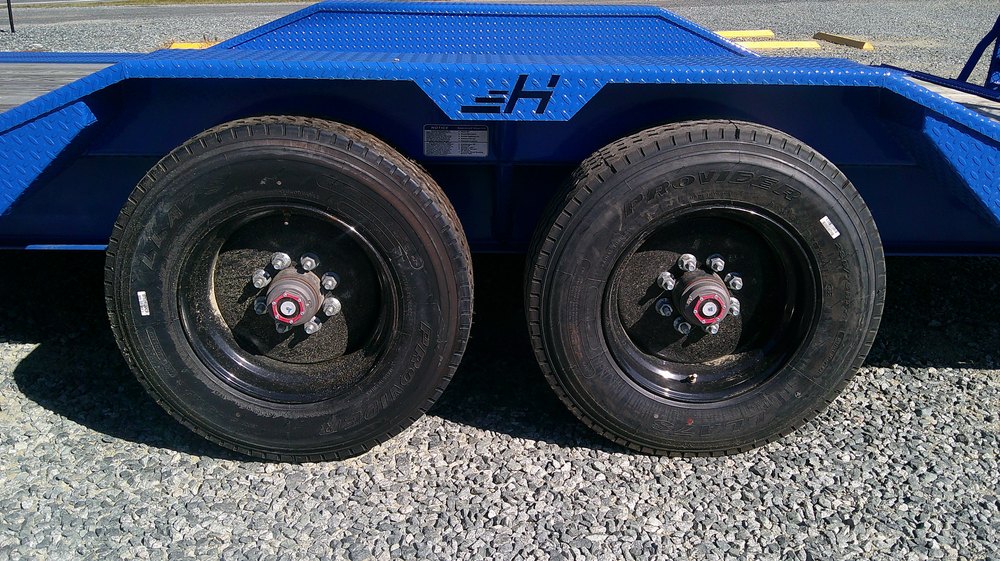
Equipment trailers get loaded near their rating routinely, which stresses axles and suspension harder than a trailer hauling light loads occasionally. Uneven tire wear usually points at a bent axle or a worn bushing rather than at the tire. A trailer that sits lower on one side on level ground, or that sways more than it used to, needs a look. Leaf packs that have flattened compared to new are telling you the suspension is near the end.
Bearings wear faster on a trailer that runs heavy most trips, because the weight puts more friction and heat in the hub every mile. A hub warmer than the others after a normal drive, or a wheel with play when you rock it, means bearings need attention now rather than next month.
We tell equipment trailer owners to repack at 6 months and 12 months in the first year, then every 12 months or 12,000 miles, whichever comes first. A trailer that works at its rating every day may need it sooner, so watch the hubs between visits. When you pull a hub, look at the grease before anything else. Milky or gray grease means water got past a seal, and that seal gets replaced in the same visit or you will be back. Our post on when an axle needs replacing rather than repairing goes further into that call.
If the axle itself is bent, plan on replacement. Torsion axles cannot be repaired in the field at all. On a spring axle, a welded spindle rarely comes back to factory alignment and you pay for that in tire wear later, and straightening pushes the steel past its yield strength a second time so the bend ends up weaker than it left the factory. By the time you pay for either you are close to a new axle with a worse trailer. We replace them.
Tie-Down Point Inspection Routine
D-rings, stake pockets, and every other anchor point take tension every time a machine gets chained down, and that adds up even when nothing looks wrong. Check each one for cracked welds, elongated mounting holes, and D-rings that have bent out of shape instead of sitting flush. A tie-down that has already failed once under load gets replaced, not reused. Metal that deformed once will do it again, usually faster.
Tilt Deck Maintenance, and Which Kind You Have
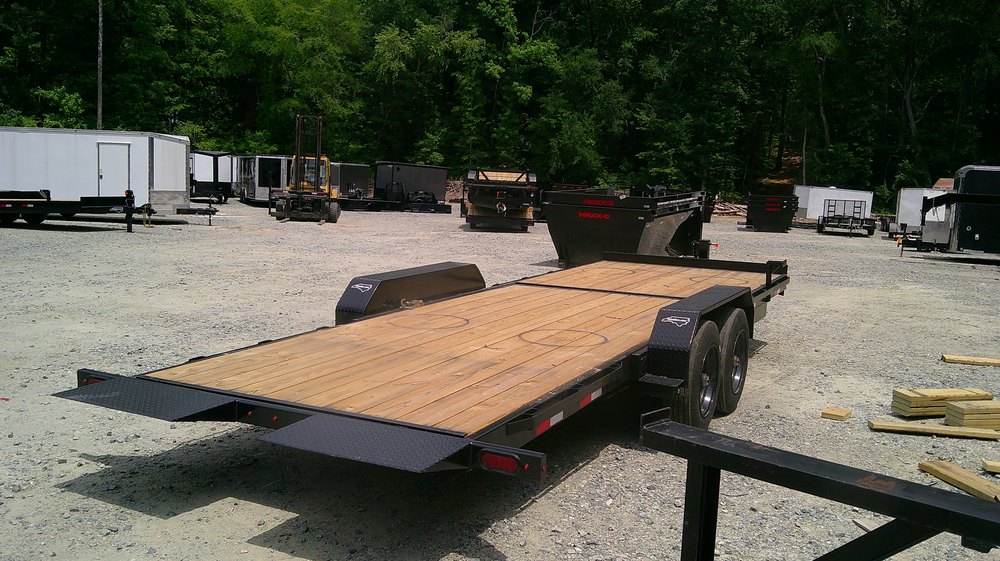
Tilt decks are not all the same, and the maintenance follows from which one you own.
| Type | How It Works | What to Maintain |
|---|---|---|
| Gravity tilt | No pump, no electrical. The weight of the machine tips the deck and a hydraulic dampening cylinder controls the speed. | The dampening cylinder and the pivot. If the deck slams down instead of easing, the cylinder is done. Gravity tilt is limited to one piece of equipment at a time, since the deck tilts under the weight. |
| Power tilt | Electric motor driving a hydraulic pump. | Cylinder, pump, hoses, battery, and connections. Same checks as a dump trailer's hydraulics. |
| Partial tilt | Front section stays fixed, rear tilts. 60/40 is typical. | Pivot hardware plus whichever actuation it uses. The fixed front is the point, since you can keep a load up there. |
On anything with a pump, check for fluid at the cylinder base and the hose fittings, and listen for a pump that strains or hesitates before the deck moves. A deck that lowers unevenly or drifts down on its own after you raise it is a seal or valve problem, and it gets worse from there.
Federal Inspections on Commercial Equipment Trailers
If you run the trailer for business and its GVWR is over 10,000 lb, or you cross a state line with it for work, it needs an annual federal safety inspection. Equipment trailers on our lot run from 7,000 to 21,000 lb GVWR, so most of them are over that line. The trailer passes its own inspection even if your truck is already compliant, and the sticker goes on the tongue. We do them at both locations, and it is a good time to have the ramps, tie-downs, and hydraulics looked at in the same visit. The report we complete is the J.J. Keller Annual Vehicle Inspection Report, and you keep a copy with your records while the decal stays on the trailer. Full detail is on our federal safety inspection page.
When Wear Crosses from Maintenance into a Repair Visit
Greasing hinges, checking pressure, tightening hardware, and topping off hydraulic fluid are yours. Cracked welds, a hydraulic system that will not hold pressure, and suspension that has visibly deformed are ours. Running a trailer with a compromised tie-down or a cracked ramp weld puts whoever is loading it at risk, and that is not a later problem.
The test that works: adjustment or replacement. Tightening a bolt, adding grease, topping off fluid is adjustment. Welding a cracked frame, replacing a bearing, swapping a leaking cylinder is replacement, and replacement wants a technician and the right tools the first time.
NC Trailers' Service Support for Equipment Trailer Owners
If your trailer is showing any of the above, bring it to Thomasville or Winston-Salem before it turns into downtime. If you are shopping instead of repairing, we carry Nolan, Maxx-D, Big Tex, Horizon, Kaufman, and Superior Trailers of GA equipment trailers, with Nolan the volume brand on our equipment lot. Our guide to the best equipment trailers for construction companies covers models built for daily heavy loading, and you can browse the equipment trailer inventory to compare. We work with over 20 lenders and accept all credit types, so trailer financing is there if a trailer has reached the end of being worth repairing.
Time to get your equipment trailer looked at?
Call us, stop by either lot, or send us the details through the service intake form and we will get right back to you.
 About the Author