

Tiny houses? What about them?
Tiny houses are a thing of the future. They have been around for years but in the past year or so, the van life and tiny home trend has taken off. In this article, we are going to discuss the practicality, the pros, and cons of living in a tiny home that is towed on a trailer base.
How practical is it?
Well from a practicality standpoint it's far more practical than buying a stationary home in terms of cost, maintenance, taxes, and well you're able to move it to where ever you want to. Spending 50k-100k total at the absolute most on something already built and ready to tow is a very alluring option. You can spend far less and build one on your own, all you would really need to purchase would be building supplies and a trailer to build on.
But why would you want to do this rather than buying and investing in a stationary home?
The answer is simple, freedom. Building a small house on a trailer that you can tow provides the ultimate level of freedom. You can do whatever you want to and go wherever you want to. The only thing you have to worry about is finding a place that will let you park and finding a vehicle capable of towing your trailer.
What are the pros to building a tiny home on a trailer?
All you need are building materials and a trailer to build on. Then it's fairly straight forward. You build as if you were building a small cabin, shack, or well house. Then you insulate, wire and find out how you're going to power everything inside.
A couple of big pros for living this sort of lifestyle outside of the sheer freedom would be low costs, cheap maintenance, no property taxes, low electricity costs, less clutter, the ability to go anywhere, no mortage and the ability to live anywhere in nature while living a much simpler and minimalistic life.
Which power source is best?
A couple of popular options are shore power, generator power, and solar power. From a mobility standpoint, the most practical out of the three would be solar power, but solar also provides the least power in general unless you have a massive amount of solar panels and a very large power bank. Most solar in general cannot power something like an air conditioning unit or heater, so if you need either, both shore and generator power are the better options. Shore power requires you to be hooked up somewhere like an RV park to actually power anything, but generator power can be used anywhere along as you have gasoline to fuel your generator. The big drawbacks to generator power are fuel costs and the sound output of a generator, they make a ton of noise.
What about the cons of tiny house living?
Obviously there are some cons. No living situation is truly perfect or without any flaws.
1) Limited living space - Well this is the big, obvious con. You have much less living space than you would in a traditional home or apartment. In an average sized house you might have 1500-2000 square feet. In a tiny
house you might have 200-300 square footage. You're largely limited to the space available on whatever trailer you decide to build on. You can only build up, you can't build out passed the space you already have.
2) Limited Storage Space - You're not going to have an attic or a garage. Your space is highly limited so your storage will be as well. This is a really big trade off. Less space, and less storage but ultimate freedom? Is it worth it? We surely think so.
3) Zoning - Most tiny houses are too small to meet the minimum size rules for a house on a residential lot, so where you build it and where you keep it both matter. The rules vary a lot from one county and city to the next, so call your local planning or inspections office before you start rather than after.
4) Financing - You're not going to be able to get a mortgage for something like a tiny home, and getting a 50-100k loan could be a challenge, but it's not impossible. The trailer itself is a different story, and that is the part we sell, so ask us about trailer financing. If you're going to have trouble financing a pre-built tiny home, your best bet is to buy a trailer yourself and building a tiny home on top of it on your own.
5) Finding a place to park your home - It could be a little bit of a challenge to find a place to park your home once it's built. Sure you can drive it pretty much anywhere but it would be much less than ideal to park your home in a Wal-mart parking lot or on public lands for any period of time. Your best bet is a mobile home park or RV park. Some senior living rv communities let younger people rent spaces. You typically can rent a spot for less than 1/5th the monthly cost of rent or a mortgage. Some even offer seasonal rent, like $3,000-$4,000 for a 6-12 month stay.
What type of trailer would I need to buy if I were to build my own?
We have several options available. We recommend buying one of our equipment trailers to build your tiny home. We recommend these because they're flat. Not all trailers are a flat surface but a flat surface is best for a tiny home.
Our equipment trailers come with a 2 inch treated wood deck, and you get either 102 inches of width on a deckover or about 82 to 83 inches between the fenders. Two sizes that work well for this are an 82x20 14K with flip-up ramps and a 102x22 (18+4) 14K with a dovetail.
Sizes and stock change constantly, so see what is on the lot right now on our equipment trailers page.
Another Option: Build an Overnight Camping Trailer
If a full tiny home is more project than you want to take on, there is a middle road. Instead of building on an open equipment trailer, you can build out an enclosed trailer as an overnight camping trailer.
Bathrooms, lights, beds, kitchens, propane and generators are all options available on enclosed trailers. This is work we do ourselves. We install generators and we service them, and we install propane, electrical, appliances, plumbing and bathrooms.
We can also order a unit built with those options straight from the factory. That is worth asking about, because it is often cheaper to have a trailer built with the options than to buy a plain one and upfit it afterward.
It is worth a look either way, and it may be more affordable than you think, especially with our financing options.
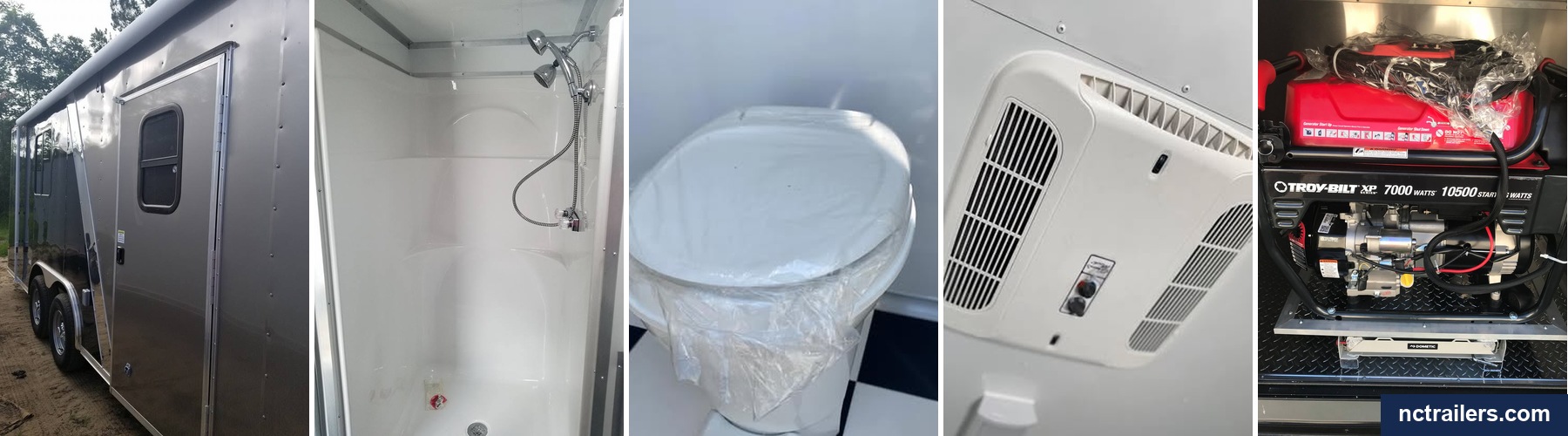
Every one of those is on a trailer we built out. Start with one of our enclosed trailers and we will go from there.
The Tiny House Movement in our own Community:
Oddly enough, we've recently seen some of the Tiny House Movement in our own backyard. Two separate communities have broken ground, to build tiny houses on residential property in our area. Those broke ground in Greensboro and High Point. It's pretty exciting!
In conclusion, a tiny home on a trailer is fairly practical, low cost, and gives you the ultimate freedom to park and live wherever you would like. It is a drastic life change that requires a little getting used to but in the end, it is very worth going for.
Looking for the right trailer to build on?
Call us, stop by either lot, or fill out the financing request just below and we will get right back to you.
 About the Author